Every fall, the same sad parade shows up on commuter trains and sidewalks: women and men in excellent coats, solid boots, good posture, and a scarf situation that ruins the whole silhouette. The neck is a narrow column, roughly the diameter of a coffee mug, and yet people pile on layers of knit, silk, wool, and fringe as if they are trying to fill a pickup truck bed. The result is a head that appears to float on a puffy cloud of fabric, with no visible transition from shoulders to chin. It is a fixable problem, and the fixes are mostly about subtraction and proportion.
Scarves are the only cold-weather accessory that gets to sit directly against the face, which means they carry an outsized visual weight. A coat can be boxy and still look intentional. A hat can be slightly off and read as quirky. A scarf that crowds the neck does something worse: it shortens the whole upper body and makes the wearer look like a snowman assembled in a hurry. The mistakes below are the usual culprits, and each one has a clear, concrete alternative that does not require buying a new wardrobe.
The blanket-square fold with a thick knit
The oversize blanket scarf, folded in half to make a triangle, then wrapped so the point hangs down the back, then flipped over the shoulder, is a look that works for exactly one body type: a very tall person with a very long neck. For everyone else, it creates a solid wall of fabric from earlobe to collarbone. The fold multiplies the density. A scarf that is already thick gets doubled, then tripled, and the neck disappears entirely.
The geometry is the problem. A blanket scarf is designed to cover the shoulders like a shawl, not to be cinched around the throat. When folded and wrapped tight, it bunches under the chin and adds roughly three inches of apparent neck width. A person with a perfectly normal 14-inch neck suddenly looks like they have a 17-inch neck, and the face reads smaller and rounder by contrast.
The alternative is to wear the blanket scarf as a shawl, draped flat over the shoulders with the coat open, or to skip the fold entirely and simply toss it around the neck once, letting the ends hang long. The loose drape preserves the vertical line. The fabric frames the face instead of burying it.
The double-wrap with a chunky cable knit
Chunky cable-knit scarves are wonderful pieces of textile engineering. They keep a person genuinely warm at temperatures that make other scarves feel like netting. But wrapping a cable-knit twice around the neck is the fastest route to a silhouette that looks like a tire stack. Each cable ridge adds visual texture, and the double wrap multiplies that texture into a solid, heavy band.
The physics of the problem are simple. A single wrap of a chunky scarf already measures four to five inches of vertical fabric. A double wrap puts eight to ten inches of dense knit between the chin and the collarbone. That is an entire hand's width of fabric. On a person of average height, it eats the entire neck and a good portion of the jawline.
The fix is to let a chunky scarf do one job: hang. Drape it over the neck without wrapping, so the folds stack on the chest rather than the throat. The front layers provide warmth where the coat buttons gap, and the neck stays visible. Loose ends can be tucked into the coat for a cleaner line.
The tight knot directly under the chin
The tightly knotted scarf, pulled snug so the knot sits right at the adam's apple or the base of the chin, is a common move on windy days. It feels secure. It keeps cold air from traveling down the collar. It also creates the visual effect of a head balanced on a ball of fabric, because the knot adds a bulge at exactly the point where the neck should taper inward.
This mistake is most visible in photographs from the side. The profile shows a sharp upward angle from the chest to the knot, then a sudden vertical drop to the chin. The neck disappears in a way that reads as defensive posture, even when the wearer stands perfectly straight.
Moving the knot down by three or four inches changes everything. Let the scarf cross at the collarbone, with the knot sitting in the hollow of the chest. That lower position preserves the warmth seal while restoring the visible length of the neck. The difference is immediate: the face gets its frame back, and the shoulders look broader by comparison.
The fringe avalanche at the collarbone
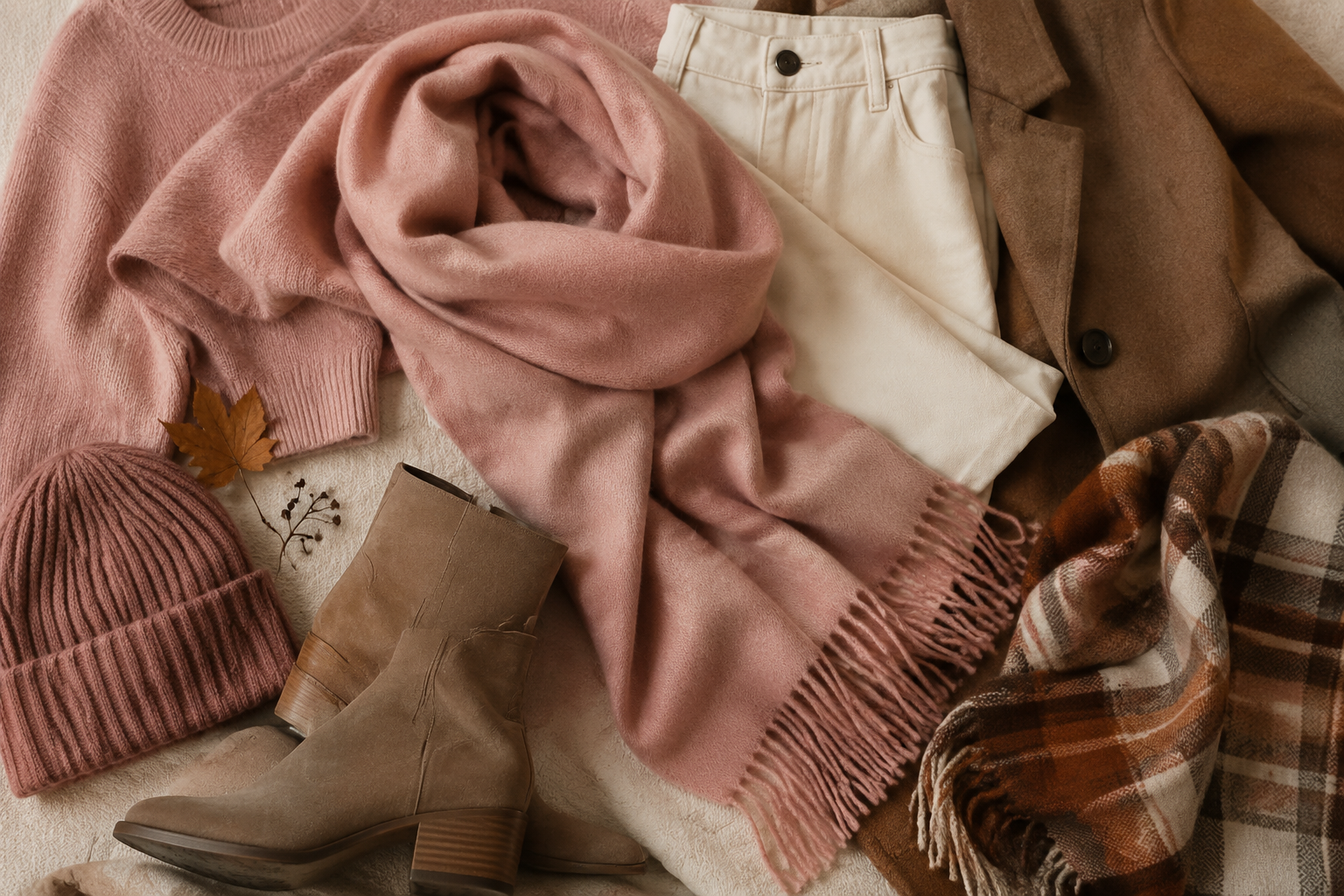
Long fringe, the kind that hangs four to six inches below the body of the scarf, is a decorative choice that has a hidden cost. When the scarf is wrapped so the fringe ends up resting directly on the collarbone and upper chest, it creates a busy, fragmented texture right at the neckline. The eye has nowhere to rest, and the neck gets visually chopped into pieces by the dangling strands.
This is especially true for scarves with densely packed fringe, where the strands multiply into a sort of grass skirt effect. The combination of the scarf's main body, the fringe, the coat lapels, and the visible shirt collar creates four competing horizontal lines in a span of about five inches. That is too much visual noise for such a small area.
The fix is to let the fringe do what it is made for: hang at the ends, away from the face. Wrap the scarf once and tuck the fringed ends into the coat, or let them hang down the front at chest level, not bunched at the collarbone. If the fringe is the point of the scarf, it deserves room to move. Packed against the neck, it just looks like a shedding animal.
The infinite loop of thin fabric
There is a category of scarf made of very thin, slippery material, often viscose or a lightweight silk blend, that comes in a long rectangle and gets wrapped around the neck four or five times in a loop. The intention is a cozy, layered look. The result is a neck that looks wrapped in gauze, with no structural definition, and the multiple layers compress into a flat, lifeless band that makes the chin look soft and undefined.
Thin scarves have a different problem than thick ones. They do not add bulk, but they add repetition. Five loops of thin fabric create five visible horizontal ridges, and each ridge shortens the perceived neck. The eye counts the layers even when the brain does not register them consciously. It is the visual equivalent of a low humming sound: not loud, but persistent and distracting.
A thin scarf works best as a single loop with long tails, or as a necklace-like drape worn inside the coat collar. One loop, loosely arranged, gives the neck a slim vertical accent. The multiple-loop style should be retired unless the wearer is deliberately going for a cocoon look, and even then it reads better in editorial photos than on actual sidewalks.
The collar-and-scarf collision
One mistake deserves special mention because it is a combination error. A coat with a high, structured collar, like a funnel neck or a dramatic lapel, paired with any wrapped scarf, creates a layered pile-up at the back of the neck. The coat collar stands up, the scarf wraps over it, and the two fight for the same space. The result is a hump behind the head and a front view where the scarf appears to be strangling the coat.
The rule of thumb is simple: a high collar and a wrapped scarf cannot coexist. One has to yield. A coat with a tall collar calls for a scarf tucked inside the coat, not wrapped over it, or no scarf at all with the collar popped. A scarf worn over the coat demands a collar that sits flat or lies open. Trying to do both creates a neck that looks like it is wearing a neck brace under a turtleneck.
The test for this, and for every scarf mistake in this list, is the profile check. Stand sideways in front of a mirror or take a quick photo from the side. If the line from the ear to the shoulder is interrupted by more than a finger's width of fabric, the scarf is doing too much. The neck is a structural element of the body, and covering it entirely is the only sure way to make a person look shorter, wider, and more cramped than they actually are.
A scarf should be a frame, not a pillow. It should leave a visible gap between the chin and the first fold, or it should hang away from the throat entirely. The warmth argument only goes so far: a person's neck radiates heat, and trapping that heat with a thick layer is possible without stacking everything directly under the jaw. The best scarf wearers, the ones who look effortlessly put together, are usually the ones who have made one simple decision: the scarf sits below the neckline, not on it.