Tote Bag vs Backpack: Which Wins for Hybrid Workweeks
Most people chose their work bag by accident. A backpack survived university, so it now carries a laptop to the office. A tote was free with a magazine subscription, so it has become the default for client lunches. For hybrid workers, the choice deserves more thought than that, because a hybrid week is not one commute. Monday might be a train ride with a packed lunch. Thursday might be a forty-minute walk, a stop at the grocery store, and a meeting that runs long. One bag has to absorb all of it, and the difference between a good week and a resentful one often comes down to how the load rides on the body.
The tote bag and the backpack are not competing on style. They are competing on physics. The tote hangs from one shoulder, which means the spine takes the load asymmetrically. The backpack distributes weight across both shoulders and the upper back. That mechanical difference drives everything else: what fits, what hurts after a month, what survives a rainy evening, and what a person actually wants to carry into a conference room.
The Weight Question Nobody Answers Honestly
Manufacturers list bag weight as if it were a specification like screen resolution. A tote weighs 400 grams empty, a backpack weighs 900 grams. The numbers look close. They do not matter. What matters is how a full bag feels at the end of a day, and that depends on body mechanics, not the dry weight of the shell.
A loaded tote, say five kilograms, pulls down on one side of the torso. To stay upright, the wearer subtly leans away from the load. The shoulder muscles on the loaded side work constantly. The trapezius and the levator scapulae do overtime. After a few hours, the neck on the loaded side feels tight. After a season of daily totes, the imbalance becomes a habit, and the body starts list. This is not a medical diagnosis, just the general understanding of how uneven load affects posture.
A backpack with a properly adjusted sternum strap and hip strap does not create that imbalance. The load sits close to the center of mass. The shoulders share the work. The spine stays relatively neutral. For a person who carries more than four kilograms on a regular basis, the backpack is not a preference, it is a relief.
The catch is that few people carry four kilograms. Many hybrid workers carry a laptop, a charger, a water bottle, a lunch container, and a notebook. That load lands between three and six kilograms depending on the laptop and the lunch. The water bottle alone is a kilo of dead weight. The math is simple: a backpack only wins if the load is genuinely heavy. A light tote, under two kilograms, is rarely a problem.
Organization and the Tote's Black Hole Problem
A tote is a single large cavity. That is its strength and its ruin. Things go in, things go out, and somewhere in between, things disappear. Keys slide under the laptop. A phone vanishes beneath a scarf. A small cosmetics pouch sinks to the bottom and takes a full minute to retrieve while standing in a doorway with rain dripping from the hood.
Backpacks solve this with compartments. A dedicated laptop sleeve, a fleece-lined pocket for sunglasses, a key clip, a side pocket for the bottle. The structure forces the wearer to put things back in the same place every day. The habit builds quickly, and after two weeks, a person can find the charger by feel, without looking.
But the organization is only useful if the wearer uses it. Many people do not. They throw the backpack on a chair at the office and stuff papers into the main compartment, creating a layered chaos that is harder to navigate than any tote. The difference is not the bag, it is the behavior. A disciplined person can keep a tote tidy with pouches and organizers. A careless person can destroy the order of a forty-pocket backpack in a week.
The honest version of the recommendation: pick the bag that matches the existing habits, not the bag that demands new ones. A person who already uses pouches and small cases will be fine with a tote. A person who throws everything in one pile will benefit from a backpack's enforced zoning.
The Commute That Changes Everything
A hybrid schedule has a shape that a five-day office schedule does not. The Tuesday morning rush hour with a packed train, the Friday afternoon walk to a café, the Wednesday work-from-home day where the bag never leaves the apartment. The bag has to perform across these different conditions, and each condition demands something different.
On a crowded train, a backpack is a weapon. It swings, it catches on straps and handles, it hits strangers in the face when the wearer turns. The polite move is to take it off and hold it at the feet, which defeats the purpose of wearing it. A tote, on the other hand, slides off the shoulder and sits on the lap or between the feet with minimal fuss. In a packed standing car, the tote wins.
On a walking commute, the backpack wins decisively. The weight distributes evenly, the hands stay free for a coffee or a phone, and the body stays balanced even on uneven sidewalks. A tote on a long walk creates the shoulder strain described earlier, and it also lets the bag swing and bump against the hip with every stride. The wearer compensates with a slight arm tension, holding the bag steady, which adds fatigue over a twenty-minute walk.
The hybrid week has both a train day and a walking day. No single bag wins both. A person who commutes by train four days a week and walks once will suffer with a backpack on the train. A person who walks four days and trains once will suffer with a tote on the walk. The correct answer depends on which commute dominates, and most people do not count their steps before choosing a bag. They choose by aesthetic or by habit, and then they complain about their neck.
The Professional Presentation Problem
There is a persistent belief that a backpack looks unprofessional in a meeting. The belief has some basis in reality, but less than people think. A clean, structured leather backpack reads as deliberate and modern. A battered nylon backpack with a carabiner and a faded logo reads as student gear. The problem is not the backpack, it is the specific backpack.
The tote has the opposite problem. A unstructured fabric tote with a brand name printed on the side reads as a grocery bag or a conference freebie. It does not signal professionalism either. The tote only wins the style contest when it is structured, made of quality material, and carried without visible strain. A floppy canvas tote that sags at the bottom and spills content when set down looks worse than a neat backpack.
For client-facing work, the material quality matters more than the format. A person walking into a pitch with a worn, creased tote looks unprepared. The same person with a clean, structured leather backpack looks organized. The issue is not the shape, it is the state. A tote in good condition with a laptop sleeve and a clean interior reads as professional. A backpack in good condition with the same features reads the same way.
The one context where the tote clearly wins is the business lunch or dinner. A backpack has to be taken off and set somewhere, which is clumsy at a table. A tote hangs on the back of the chair or rests on an empty seat. For the person who ends the day with a client dinner, the tote is the practical choice.
Weather, Rain, and the Contents Survival Test
Rain is the silent differentiator. A backpack, worn on the shoulders, keeps the contents mostly sheltered under the umbrella or the hood. A tote, carried at the side, hangs exposed to splashes from passing cars and to the rain that catches the opening. The modern fabrics help: waxed canvas, coated nylon, treated leather. But the opening remains the weak point. A tote with an open top invites water in. A backpack with a top flap or a zipper keeps the rain out.
Puddles are another story. A backpack gets set down on wet ground at the café, at the station, at the bus stop. The bottom absorbs moisture. A tote can be set on a chair or a bench, keeping it clear of the ground. The wearer controls where the backpack goes, but the habit of setting it on the floor runs deep. Waterproof bottoms exist on both formats, but few people seek them out before the first soak.
The real test is the laptop. A backpack with a dedicated, raised laptop sleeve keeps the machine dry even when the outer shell is wet. A tote with a vertical laptop pocket does the same, but only if the pocket is deep enough to keep the top edge below the rim. Many totes have laptop pockets that stop mid-way, leaving the top corner exposed to rain that runs down the side. The check is simple: put the laptop in the bag, look at the top edge, and see if it clears the bag's opening. If not, the rain finds the machine.
The Empty-Bag Day and the Tote's Quiet Advantage
Not every hybrid day is a heavy day. On a Wednesday with no laptop and no lunch, the load shrinks to a phone, a wallet, a notebook, and a pen. The backpack becomes an empty shell, still bulky on the shoulders, still taking up space on the train seat. The tote collapses to nearly nothing. It hangs flat, slides into a drawer, and takes up no visual space.
This is the case for owning both. A person who works three days in the office and two at home carries a different load on each day. The heavy day, Monday, calls for the backpack. The light day, Thursday, calls for the tote. The hybrid schedule is not a single bag situation. It is a rotation, and treating it that way solves most of the problems outlined above.
The counter-argument is the transfer ritual. A person who switches bags every day has to move the phone, the keys, the wallet, the charger, the badge, the pen. That ritual takes ninety seconds, but it also creates the risk of forgetting something critical. The badge left in the other bag means a walk back to the apartment. The charger left behind means a dead laptop at the office. Many people solve this by committing to one bag, accepting the flaws, and never switching.
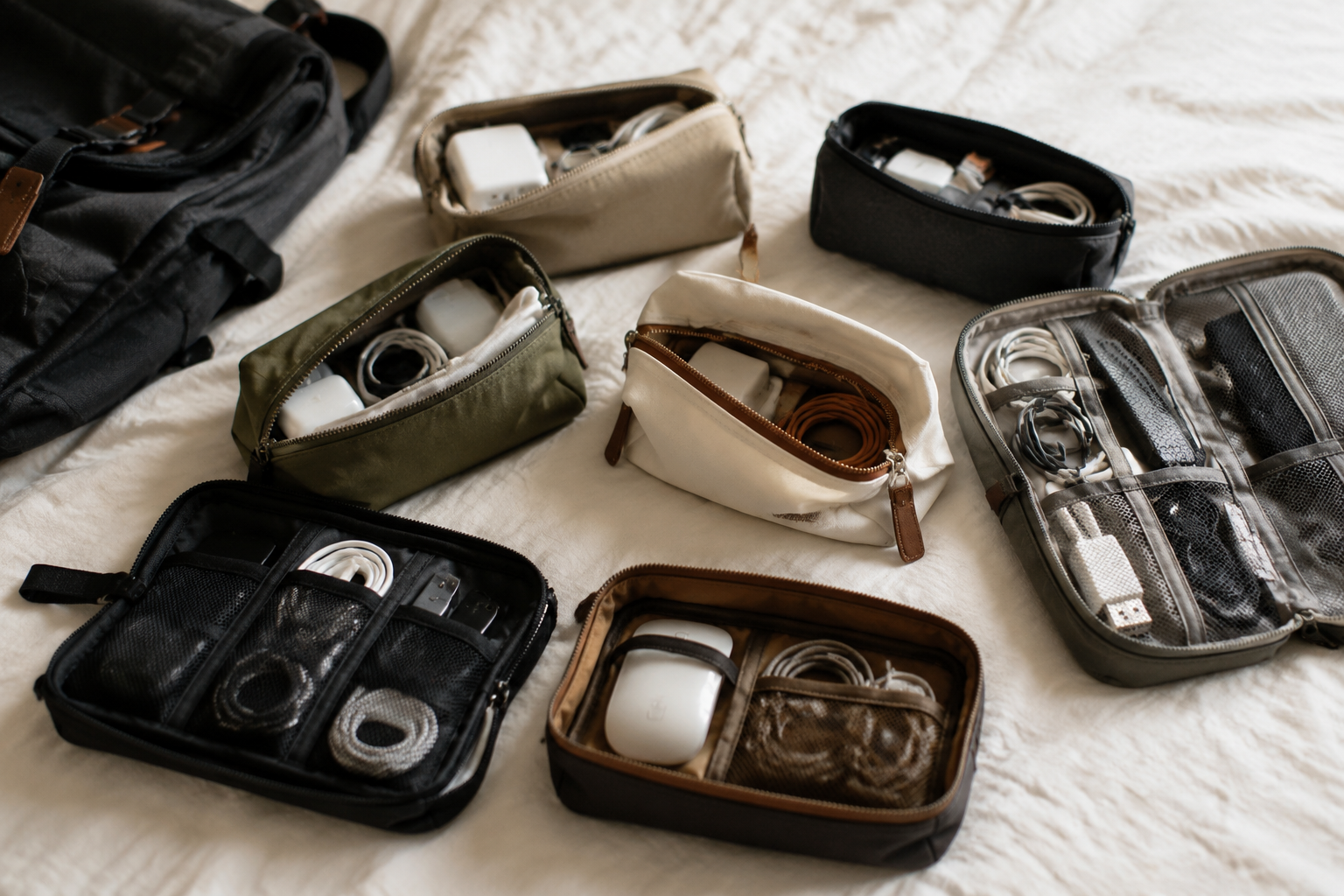
The better solution is a small organizer that moves between bags. A compact pouch holding the charger, the cables, the badge, and the pens. The pouch goes into whichever bag is being used that day. The transfer takes five seconds, not ninety. This is the hybrid worker's actual trick: not choosing one bag, but building a system where the bag itself is interchangeable.
The Shoulder That Remembers
Bodies keep a record of bad decisions. The shoulder that carried a heavy tote through a summer of commutes remembers it the following winter. The neck that tilted against a sling bag's pull develops a tight spot that a massage therapist can find blindfolded. These are not dramatic injuries. They are the slow accumulation of daily micro-strain that most people write off as just getting older.
The backpack delays that accumulation. A well-fitted backpack transfers the load to the hips and the core, which are built for it. The shoulders stay relaxed. The spine stays neutral. After a week of commuting with a backpack, the body feels less tired at the end of the day. This is not a claim that backpacks prevent injury, just that they reduce the specific strain that an asymmetric load creates.
The tote's defense is that it forces the wearer to carry less. A tote cannot hold two laptops and a full change of clothes without becoming visibly absurd. The weight limit is built into the format, and that limit protects the shoulder. A backpack, with its generous capacity, invites overloading. The person who stuffs the backpack with everything might end up carrying eight kilograms, and no backpack design can save a spine from eight kilograms of daily abuse.
The rule for a backpack: pack it like a tote. Take the heaviest item, the laptop, and the essentials. Leave the rest at home. A backpack used with tote-level discipline is the best of both worlds. A tote used with backpack-level capacity is a slow injury.
A Season of Testing on the Actual Street
After a month of alternating between a waxed canvas tote and a structured backpack on a mixed commute, the pattern becomes clear. The tote works on the days with a light load and a short walk. The backpack works on the days with a laptop, a lunch, and a long walk through the city. The days where the commute involves a folding bike or a train transfer favor the backpack, because the hands need to be free. The days with a client lunch favor the tote, because the bag needs to sit on a chair without looking like luggage.
The single biggest surprise is how much the walking distance matters. A fifteen-minute walk with a tote is fine. A thirty-minute walk with the same tote is a different experience. The shoulder starts to burn around minute twenty. The bag swings more, the arm tenses, and the walk stops being pleasant. The same walk with a backpack is neutral, uneventful, and comfortable. Nobody notices a backpack on a walk. Everyone notices a tote.
The verdict is not a verdict in the sense of one winner. It is a division of labor. The tote is the light-day bag, the meeting-day bag, the day when the load fits in a pouch. The backpack is the heavy-day bag, the walking-day bag, the day when the body needs a break. The hybrid week, with its alternating rhythms, is not designed for a single bag. It is designed for two.
The person who owns one bag is making a statement about their tolerance for strain or their tolerance for disorganization. The person who owns two is making a statement about the actual shape of their week. That second person has a better week. Their shoulder does not hurt, their keys are always findable, and their laptop stays dry in the rain. That is the whole argument. Choose the bag that matches the day, and the day stops being a test of endurance.