Rainy Mondays occupy a strange category in the wardrobe calendar: they are not special enough to demand a plan, but they are disruptive enough to punish a careless one. The person who walks into the office looking assembled on a day that starts with sideways drizzle has done something quietly impressive. This is not about buying a new raincoat or a pair of hundred-dollar boots. It is about understanding what actually goes wrong on wet days and addressing those specific failures, one layer at a time.
The first failure is almost always the shoes. People treat waterproofing as a binary: either the shoe is a rubber boot or it is not. But the real problem is the gap between the curb and the covered entrance, the stretch of sidewalk where the puddle forms right at the edge of the awning. That gap is about twenty feet, and it ruins more outfits than any downpour. A leather sole, even a well-maintained one, will wick moisture up into the footbed within minutes. The solution is not a dedicated rain boot, which looks wrong in most offices and feels worse on the train. It is a shoe with a sealed construction: a Goodyear-welted or cemented sole with a raised heel block, or better yet, a rubber-sole Derby with a storm welt. The distinction matters because a storm welt has an extra strip of leather that curves up and over the seam where the upper meets the sole. That tiny flap of material is the difference between a shoe that survives a damp Tuesday and one that leaves a sock-shaped puddle under the desk by noon.
Once the shoes are handled, the next casualty is the trouser. Nothing ages a person faster than a hem that has been dragging through water, darkening at the bottom, clinging to the ankle like a wet napkin. The standard advice is to cuff the trousers, but that only works if the cuff is rolled tight and high enough to clear the deepest puddle, which is rarely the case. A better approach is to choose the trouser for the day with the rain in mind. A slightly cropped cut, one that breaks just above the ankle bone, clears the wet zone entirely. This is not a fashion statement; it is a practical length that happens to look deliberate. For those who cannot wear cropped trousers to work, the alternative is a pair with a high-twist wool weave, which dries quickly and resists water absorption better than cotton or linen. The fabric matters more than most people realize. A tight, compact weave will shed droplets for the first hour; a loose, fluffy knit will soak through in five minutes.
The coat is where most people overcorrect. The instinct on a rainy Monday is to reach for the heaviest, most technical shell in the closet, the one with taped seams and a hood that looks like a bicycle helmet. That coat keeps the rain out, but it also turns the wearer into a raincoat. The whole outfit underneath becomes irrelevant because the shell dominates, visually and literally. The better move is a coat that is appropriately waterproof for the commute and no more. A waxed cotton jacket, for instance, handles light to moderate rain beautifully, has a classic silhouette, and does not scream emergency preparedness. It will not survive a monsoon, but it will handle the standard Monday drizzle, and it looks like clothing rather than equipment. The key is to re-wax it before the season starts; a dry, cracked wax coating is just a very expensive way to get wet. For those who need something dressier, a raglan-sleeve trench in a tightly woven cotton blend works. The raglan sleeve is not a stylistic accident; it eliminates the shoulder seam, which is the first place water seeps through on a conventional jacket.
An umbrella is not a backup accessory; it is the single most important decision of the morning, and most people get it wrong. The compact folding umbrella, the one that lives in a bag and emerges only in emergencies, is a trap. Its short canopy leaves the shoulders and the lower back exposed, and its small diameter means the rain drips directly onto the trouser hem that was just carefully chosen. The fix is counterintuitive: carry a full-length umbrella, the kind with a curved wooden handle and a canopy that spans at least forty inches. It covers the shoulders, it keeps the torso dry, and it creates a dry zone around the lower legs. The weight is a minor inconvenience; the dryness is a major comfort. The color matters less than the mechanism. A manual open-close mechanism is more reliable than an automatic one, which jams at the worst possible moment. And the canopy should be made of a nylon or polyester that dries quickly; a cotton canopy, while elegant, stays damp for hours and drips on everything it touches.
What goes under the coat is the part most style advice skips entirely, and it is the part that determines whether the day feels composed or compromised. Rainy days have a way of turning any room into a cross between a greenhouse and a freezer. The office thermostat does not account for the humidity outside, so the indoor climate alternates between clammy and chilly. The solution is a thin, high-collar knit layer. A merino wool turtleneck or a fine-gauge crewneck with a tight collar does the work that the coat cannot: it regulates temperature without adding bulk. Cotton is the enemy here; it absorbs moisture from the air, clings to the skin, and presents the wearer with a damp, shapeless impression by late afternoon. Merino, on the other hand, wicks, breathes, and retains its shape. The collar matters because a wet neck is the fastest route to a miserable commute. A collar that stands up, even slightly, protects the back of the neck from the drip that slides off the umbrella and down the jacket collar.
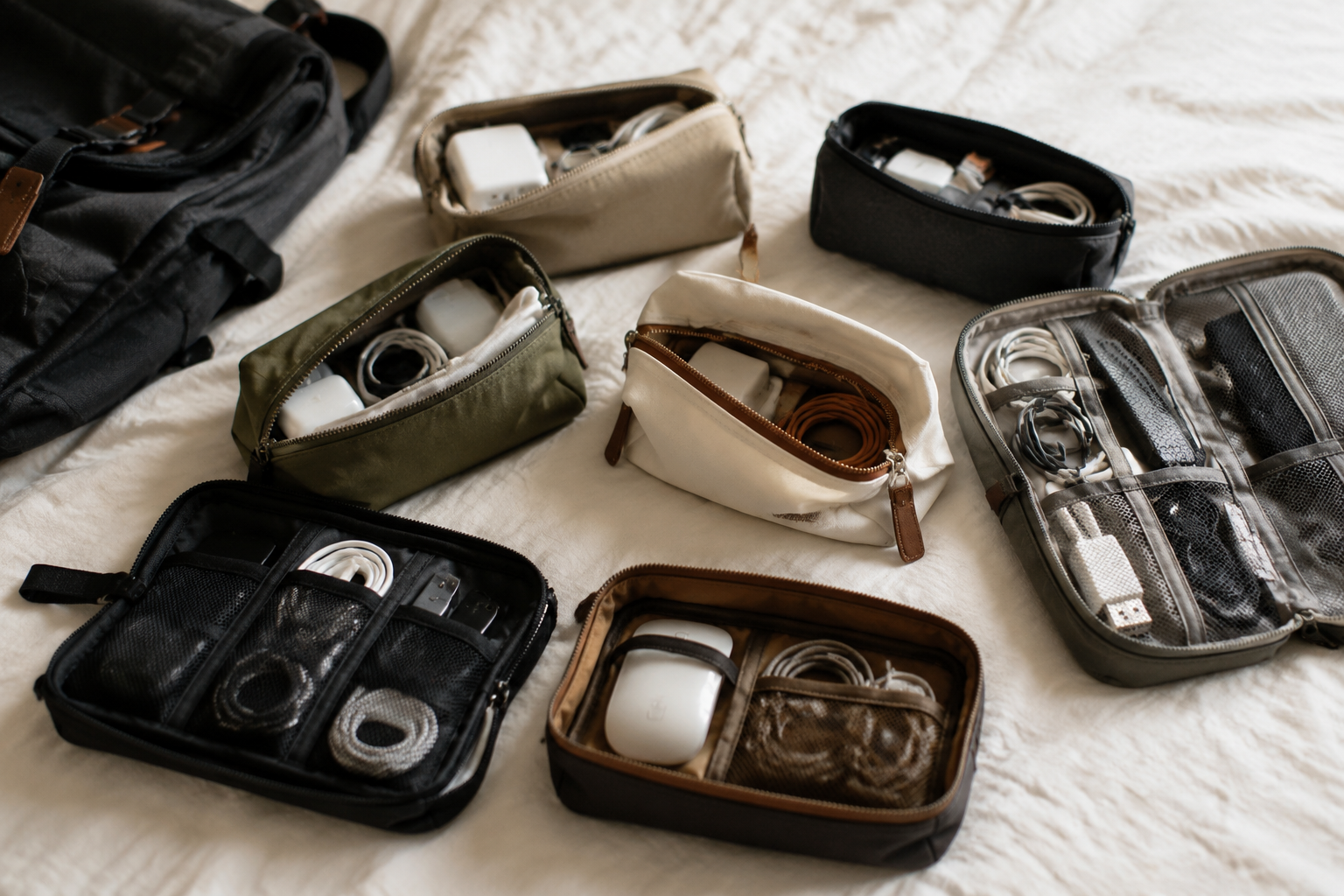
The final piece is the bag, and this is the one that most people refuse to think about until they are standing in a boardroom with a soaked laptop sleeve. Leather bags, even good ones, absorb water and show every drop as a dark spot that may never fade. Canvas bags are worse; they soak through entirely and transfer the wetness to everything inside. The practical answer is a bag with a rubberized or coated exterior, or a bag with a dedicated waterproof liner that can be removed and dried. A waxed canvas briefcase is a good middle ground, but it requires the same maintenance as the jacket. The real secret is the contents, not the container. Everything inside the bag should be double-wrapped: the laptop in a dry bag, the papers in a plastic sleeve, the phone in a jacket pocket, not the bag pocket. The person who arrives dry is not the one with the most expensive gear; it is the one who assumed the gear would fail and planned for it.
There is also the matter of the commute itself, the stretch where the look is actually tested. A rainy Monday commute has its own physics. The first ten minutes are dry, the next fifteen are drizzle, and the final five are a torrent that arrives just as the crosswalk lights turn red. The person who arrives intact has made a series of micro-adjustments: leaving the building five minutes earlier to avoid the worst of the crowd at the station, walking on the inside of the sidewalk to avoid the curb spray from buses, crossing at the intersection where the crosswalk has a slightly higher curb. These are not style decisions, but they are outfit decisions, because the outfit is only as good as the state in which it arrives. A perfect coat and a dry pair of shoes are worthless if the walk to the office ends with a splash from a passing taxi.
The last thing to consider is the end of the day, the reverse commute, because a rainy Monday look is not a one-way performance. By 5 p.m., the coat is damp, the shoes have taken on moisture, and the umbrella has been dried and re-opened at least twice. The trick to the evening is not to change the outfit but to adjust it. The knit layer that worked under the coat in the morning will be too warm for the walk home, so it should be removed before leaving, and the collar of the shirt underneath should be checked for creases. The shoes should be wiped down with a dry cloth before they go into the bag or the closet; letting them air dry on their own is fine, but leaving them wet in a dark bag is how they lose their shape. The umbrella should be closed, shaken, and secured with its strap, not jammed into a pocket while still dripping. These are small acts of maintenance, but they are the difference between a person who looks assembled and a person who looks like they simply survived the weather. The goal is to do both, to survive and to look like the day was managed rather than endured.
The real measure of a put-together rainy Monday look is not the first impression at 9 a.m. It is the second impression at 3 p.m., when the morning coat has been hung on a hook, the shoes have dried, and the person still looks like they belong in the room. That requires one more layer of planning, the one that anticipates the indoor hours. The shirt should be wrinkle-resistant, not just because of the rain, but because the humidity will set every crease in place. The belt should be leather that has been treated, or better yet, a woven leather that does not show water spots. The watch, if worn, should be on a steel or rubber strap, never leather, which will stretch and discolor within a single wet season. These are not details that anyone will notice individually. But collectively, they are what makes the difference between a person who looks like they put the day together and a person who looks like the day put them together. And that is the entire point of dressing for a Monday, rainy or not.