For years, the hair accessory aisle has been a kind of aesthetic trap. Walk into any drugstore and the options skew toward one of two extremes: glittery plastic barrettes that look like they came off a toddler’s birthday cake, or matte black metal clips that make the wearer look like she gave up on styling and simply needed to keep hair out of a face mask. The middle ground, where the accessories actually complement an outfit rather than announce themselves as an afterthought, exists. It just requires ignoring most of what is on display and knowing exactly which pieces earn their place in a grown-up wardrobe.
The bar for "grown-up" is lower than it sounds. It does not mean boring, and it does not mean expensive. It means the accessory reads as a deliberate choice, the way a good watch or a leather belt reads on a man. The difference is almost entirely about finish, scale, and how the piece behaves after a few hours of wear. A cheap clip that slides out of fine hair by noon is not an accessory, it is a frustration. A barrette that leaves a permanent crease and then snaps in half is not a style choice, it is a piece of garbage.
What follows is a short list of accessories that pass the test. Each one has been worn enough to know where it works, where it fails, and why it does not make the wearer look like she is heading to a middle school dance.
The French Barrette That Does Not Look Like a Hair Clip
The French barrette has a reputation problem. Most versions sold today are cheap enamel things with a weak spring clasp that catches strands of hair and pulls them out painfully. The good ones, the ones that actually work, are built differently. They use a longer, flatter clasp mechanism that sandwiches the hair rather than pinching it. The back is smooth, not ridged, so it does not snag. And the top, instead of being a flat painted rectangle, has a slight dome or a subtle texture that catches light.
The right way to wear one is low, at the nape of the neck, holding a gathered section of hair that is slightly loose. A person should be able to feel the clip holding, but not pressing into the skull. The finish matters more than the color. A brushed gold or a matte tortoiseshell reads as intentional. A shiny, bright red one reads as costume.
The test is simple: if the barrette looks like it could be sold in a craft store next to beads and elastic cord, skip it. If it looks like it might be a piece of jewelry that happens to have a clasp on the back, it is worth the money. The best versions cost more than a drugstore impulse buy, but they also do not break after three wears.
The Sculptural Claw That Holds a Full Day
Claw clips had a revival, and like most revivals, the market filled with cheap, oversized plastic versions that look identical to the ones from 1997, just in trendier colors. The grown-up version is smaller in scale and made from a material with some weight to it. Acetate, the same stuff used in quality eyewear, is the marker of a good one. It has a slight translucency and a warmth that cheap plastic cannot replicate.
What separates a good claw from a bad one is the teeth. They need to be rounded at the tips, not sharp, and they need to be spaced close enough to grip fine hair but not so close that they crush it. A claw with gaps between the teeth that are too wide will slide out of thin hair within minutes. A claw with teeth that are too tight will dent the hair and leave a headache behind.
The right placement is the key to looking intentional. High on the crown, gathering the top half of the hair, reads as sporty and slightly aggressive. Low, at the back, twisted into a loose knot, reads as relaxed and put-together. The latter is the grown-up choice. It says the hair was handled, not that the wearer is trying to make a statement.
A good claw should survive being thrown into a bag, sat on, and used to hold hair during a face-washing routine. If it cracks, it was not worth the ten dollars. The ones that last are the ones that feel heavy in the hand.
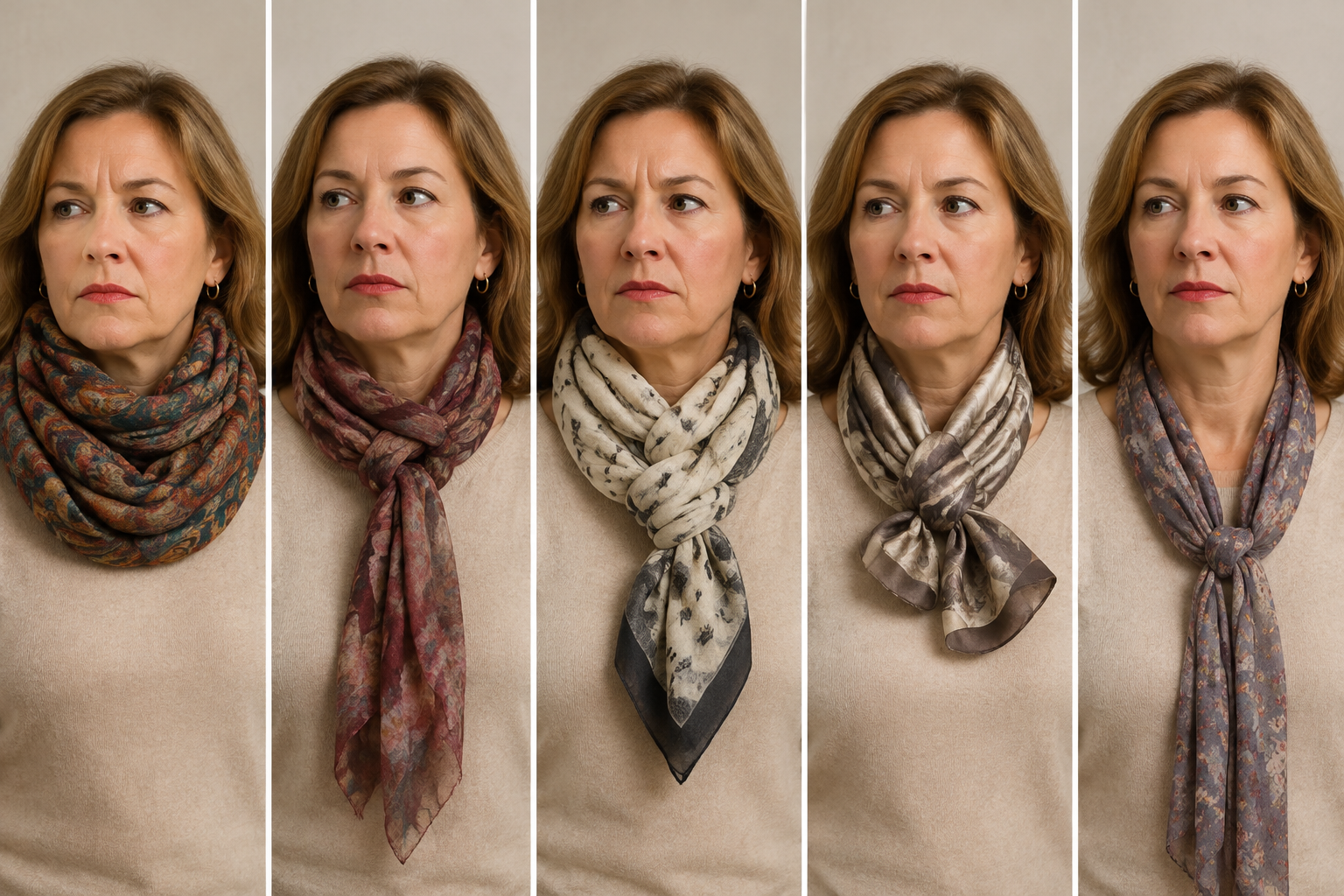
The Thin Silk Scarf, Tied Like an Adult
Silk scarves in the hair can go one of two ways: they can look like a 1950s film still, or they can look like a costume from a community theater production of "Grease." The difference is in how the scarf is tied and how much of it is visible.
The grown-up version is a square of silk, roughly 26 to 32 inches, folded into a narrow band and tied at the base of a low ponytail or wrapped around a bun. The knot is small, tucked under the fold, not flopping on top of the head like a bow on a present. The ends, if they hang, should fall no lower than the chin. Anything longer starts to look like a neckerchief, which is a different piece of clothing entirely.
Pattern matters. A small, all-over print, like a delicate paisley or a micro-dot, reads as refined. A giant logo or a bold geometric print reads as a brand billboard. Solid colors work best, especially deep tones like burgundy, forest green, or navy. These read as a deliberate accent, not a desperate attempt to inject personality into a boring outfit.
There is a practical benefit too. Silk does not pull or crease the hair the way an elastic does. It slides, which means less breakage and fewer dents. For anyone who has ever taken a ponytail out and found a permanent crimp where the band sat, the scarf is the fix. It holds, but it does not punish.
The Metal Snap Barrette in a Real Metal
The snap barrette is the one most people swore off in middle school because the hinge pinched. The modern versions, the ones made with actual metal rather than painted plastic, have fixed that problem. The hinge is smoother, the snap is gentler, and the whole thing lies flatter against the head.
Worn singly, at the temple, holding back a section of hair that frames the face, this is the closest thing to jewelry a hair accessory can be. A brushed silver barrette or one in a matte gunmetal finish looks like a small sculpture. The gold versions, if they are not too yellow, work the same way.
The trick is to keep it minimal. One barrette, not two or three scattered around the head. The trend of clipping random sections with multiple barrettes reads as a styling experiment, and it rarely lands well on anyone over twenty-five. A single, well-placed clip says the hair was considered. A cluster says the wearer was following a tutorial.
Metal barrettes are also the most forgiving option for hair that is between washes. They hold a slightly greasy section at the temple without drawing attention to it. A person can skip a wash day, clip back the front, and look polished rather than disheveled.
The Ribbon, Woven Into a Braid
A length of grosgrain or velvet ribbon, about half an inch wide and a yard long, can be woven into a single braid to add color and texture without any of the fussiness of a scarf. The ribbon is folded in half, looped around the base of the braid, and then the three strands of hair are braided with the ribbon folded into two of them. It sounds complicated, but it takes about thirty seconds of practice.
The key to making this read as grown-up is the color and the material. A matte black velvet ribbon against blonde or brunette hair looks expensive. A shiny pink satin ribbon looks like a birthday party. The texture matters too. Grosgrain has a ribbed surface that grips the hair and does not slip. Satin, despite its sheen, slides out and needs constant retying.
This is not an everyday accessory. It is for a specific occasion, a dinner out, a wedding, a day when the outfit is simple and needs a single accent. Worn on a Tuesday with a sweatshirt, it looks like a costume. Worn with a silk blouse and tailored trousers, it looks like a choice.
The ribbon should be tied at the end of the braid with a small, tight knot, and the ends trimmed to a neat angle. Frayed, raggedy ends ruin the effect.
The Padded Headband, Cut for an Adult Skull
The padded headband is the most difficult entry on this list because it is the most visible. It sits on top of the head, impossible to ignore, and it has a history of making wearers look like they are about to go horseback riding in the 1980s. The modern version, made with a thin layer of padding and a velvet or silk covering, has a slimmer profile. It does not sit on top of the head like a crown. It sits farther back, almost at the crown, holding hair away from the face.
The material is everything. A velvet headband in a deep, muted color, like rust or olive, reads as sophisticated. A satin one in a bright color reads as a bridesmaid accessory. The structure matters too. The band should be slightly flexible, able to bend without snapping, but not so thin that it digs into the temples.
This works best on hair that is worn down and slightly waved. It holds the hair back from the face, which is practical, but it also frames the face in a way that a ponytail cannot. The wearer should not tighten it against the skull. It should rest, gently, and stay in place without leaving a red mark after an hour.
The final test for any hair accessory is whether the wearer forgets it is there. A clip that pinches, a headband that aches, a scarf that needs constant adjustment, none of these are grown-up, no matter how expensive they are. The best accessory is the one that holds, stays quiet, and lets the person get on with the day. That is the entire standard.