Coastal spring has a way of making 48 degrees feel like a personal insult. The calendar says daffodils, the harbor says otherwise. A morning can begin with bright water, a gull on a railing, and enough wind coming off the bay to turn a loose scarf into a small, useless flag. The right scarf for that hour has to do a more difficult job than the wool blanket worn in January. It has to block wind at the throat, sit flat under a jacket, survive mist, and still look reasonable when the sun appears at 10:30 and the day suddenly belongs to linen shirts and coffee outside.
That is why coastal spring scarves deserve their own category. Heavy winter mufflers hold too much damp and feel absurd by lunch. Delicate silk squares look graceful in still air, then slide open exactly when the wind cuts around a corner. The best choices live in the middle: firm enough to stay tied, breathable enough to keep on indoors for a few minutes, and textured enough that a knot does not collapse.
A Ribbed Merino Scarf For The First Ferry
A narrow ribbed merino scarf earns its place on the mornings when the ferry terminal smells faintly of diesel and wet rope. Merino has the useful coastal trick of feeling warm without turning clammy as quickly as bulkier wool. In a rib knit, it grips itself. That matters when the wind keeps finding the gap between collar and jaw.
The ideal version is about 8 to 10 inches wide and long enough to wrap once with both ends tucked into a coat. Anything wider starts to bunch at the chest, especially under a rain shell or chore jacket. A ribbed scarf in charcoal, oat, sea green, or navy looks ordinary in the best sense: it belongs with a canvas tote, a waxed jacket, a wool blazer, or the slightly battered black coat that comes out every March because winter has refused to leave cleanly.
Its weakness is drying time. Merino handles a little mist, but a real rain turns it sulky. For a commute that includes open platforms, ferry decks, or long exposed walks, this scarf works best when the forecast says wind first, rain second. It is the scarf for sharp air, moving water, and the kind of morning when hands stay in pockets until the ticket is needed.
A Cotton Gauze Scarf That Still Has Some Body
Cotton gauze can go limp and decorative, which is fatal on a windy shore. The better versions have a crinkled texture and enough density to form a soft rope when twisted. They look light, but they create a surprisingly useful barrier when wrapped close to the neck and tucked into a trench coat.
This is the scarf for the odd spring morning that starts cool and ends with people carrying their jackets over one arm. A good cotton gauze scarf does not announce itself as cold-weather gear, so it can remain on after the wind drops. It also tolerates the casual indignities of coastal life: salt on a bench, damp railings, sunscreen from a forgotten tube in a bag, a coffee lid that was never as secure as promised.
Color makes a difference here. Pale cotton near a working waterfront can look tired quickly. Soft black, faded red, olive, blue stripe, or washed indigo has a better chance of aging attractively. The best cotton gauze scarf looks as if it has already been through several springs and decided to stay useful.
A Silk Twill Square For Wind Under A Blazer
Silk twill sounds too polished for a coastal morning until it is used correctly. A large square, folded on the diagonal and tied close, seals the open neck of a blazer or light wool coat with almost no bulk. It is especially good for office days in towns where the walk from parking lot to building includes one exposed block that feels stolen from February.
The key is twill, not slippery satin. Twill has a diagonal weave with enough grip to hold a neat knot. A 35 inch square gives room to fold, cross, and tie without leaving tiny ends that wriggle loose. Smaller squares can work, but they become more ornamental than protective once the wind picks up.
This scarf is at its best with a close collar: crewneck sweater, buttoned cardigan, fine knit polo, blazer lapels pulled together for the walk. It adds a layer where wind usually wins, right at the hollow of the throat. A navy ground with cream, a black and rust print, or a green geometric pattern can do more for a plain coat than another pair of earrings ever will.
Silk has limits. It does not love salt spray, and it should be untied rather than yanked loose with cold fingers. Still, for the morning that involves a presentation after a waterfront commute, it is the rare elegant thing that performs an actual task.
A Linen Blend Wrap For The Sunny Walk Back
Linen belongs to late spring in the public imagination, but a linen blend scarf can be useful much earlier along the coast. Pure linen wrinkles beautifully and sometimes abrasively. Blend it with cotton, modal, or a little wool, and it becomes softer, easier to knot, and more tolerant of days that refuse to choose a season.
A linen blend wrap should be wide enough to pull over the shoulders for five minutes on a bench, then narrow enough when gathered to sit at the neck. That sounds contradictory until the fabric is right: loose weave, dry hand, no plush thickness. It should feel like a shirt that learned to behave as outerwear.
This is the scarf for the person who leaves the house before the sun clears the rooftops and comes back along the seawall under a sky too bright for the coat they are wearing. Around the neck in the morning, it cuts the wind. Later, folded lengthwise and draped once, it shades the back of the neck without trapping heat. In washed gray, clay, deep teal, or natural flax with a darker border, it looks relaxed rather than sleepy.
Fringe should be short. Long fringe near the coast becomes theatrical in a gust and annoying around bag straps. A clean hem or one inch fringe keeps the whole thing from behaving like rigging.
A Brushed Alpaca Blend For Cold Air After Rain
After rain, coastal cold has a different texture. Pavement shines, stone walls sweat, and the air feels as if it has been stored in a refrigerator. On those mornings, a brushed alpaca blend scarf can be exactly right, provided it is chosen with restraint.
Alpaca is warm, often warmer than its weight suggests, and the brushed surface traps air in a way that feels immediately comforting. Too much of it, though, turns a spring scarf into a winter object. The useful version is medium width, loosely woven, and blended for softness and stability. It should compress under a collar rather than rise up around the face like a cushion.
This scarf suits early dog walks, school drop-offs near the dunes, and the grim little errand before work when the car windshield is wet inside and out. It does not need a complicated tie. Once around, ends crossed and tucked, done. The brushed surface holds itself in place and makes a simple dark coat look more considered.
Pattern can be useful with alpaca because the fibers soften edges. A small herringbone, muted plaid, or two-color check avoids the bathrobe feeling that sometimes comes with fuzzy scarves in pale solids. Cream alpaca near rain and coffee is brave. Charcoal with a blue check is practical and kinder to real life.
A Technical Nylon Neck Scarf For Spray And Gusts
There is a case for a scarf that borrows from outdoor gear without looking as if it has wandered off a trail. Lightweight nylon, especially when quilted thinly or backed with a soft lining, blocks wind better than many prettier fabrics. On a coastal bike ride, a dockside market run, or a walk beside open water during a small craft advisory, romance is less useful than a fabric that refuses to flap open.
The best technical neck scarves are compact. Some fasten with a snap or pull through a loop, which is excellent in wind because there are no long ends to whip into a face or catch under a backpack strap. A matte surface helps. Shiny nylon can read ski lodge, while matte black, spruce, slate, or dark burgundy sits more quietly with city clothes.
This option will never have the charm of a silk square or the softness of merino. It earns its place through obedience. It stays where it is put. It sheds light mist. It can be shoved into a pocket when the weather settles. It is also the scarf most likely to be borrowed by someone who previously claimed not to need one.
Look for low bulk at the fastening point. A padded knot under a zipped jacket becomes irritating after ten minutes. A flat snap, pull-through slit, or short keyhole shape makes the difference between clever and fussy.
A Fine Cashmere Scarf For Dry, Bright Wind
Cashmere gets praised so often that the word begins to feel meaningless, but a fine cashmere scarf has a very particular use on the coast. It is for dry wind, clear light, and the morning when the air is cold without being wet. In that weather, cashmere gives warmth with almost no weight, and it has a softness that makes repeated wrapping and unwrapping less annoying.
The coastal spring version should be thinner than the winter travel wrap sold as luxury armor. Think scarf, not shawl: about 12 inches wide, long enough for a single wrap, with a weave that feels smooth rather than fluffy. Fluffy cashmere pills faster under seat belts and bag straps, and coastal spring involves too much movement for precious fabrics that need constant guarding.
A fine cashmere scarf works beautifully with a trench, peacoat, leather jacket, or collarless wool coat. Camel is classic, but it can look a little formal against spring's wet sidewalks and white sky. Heather gray, bottle green, deep plum, tobacco, and dark navy feel less expected. A narrow stripe at the ends is even better, since it gives the scarf a small visual anchor when the rest of the outfit is made of practical layers.
Care is the tax. Cashmere should be kept away from heavy rain, dried flat after damp air, and stored clean when the warm weather finally holds. That sounds precious until compared with the alternative: a drawer full of bulky scarves that were perfect in January and wrong every morning after the clocks changed.
The Knots That Matter More Than The Mirror
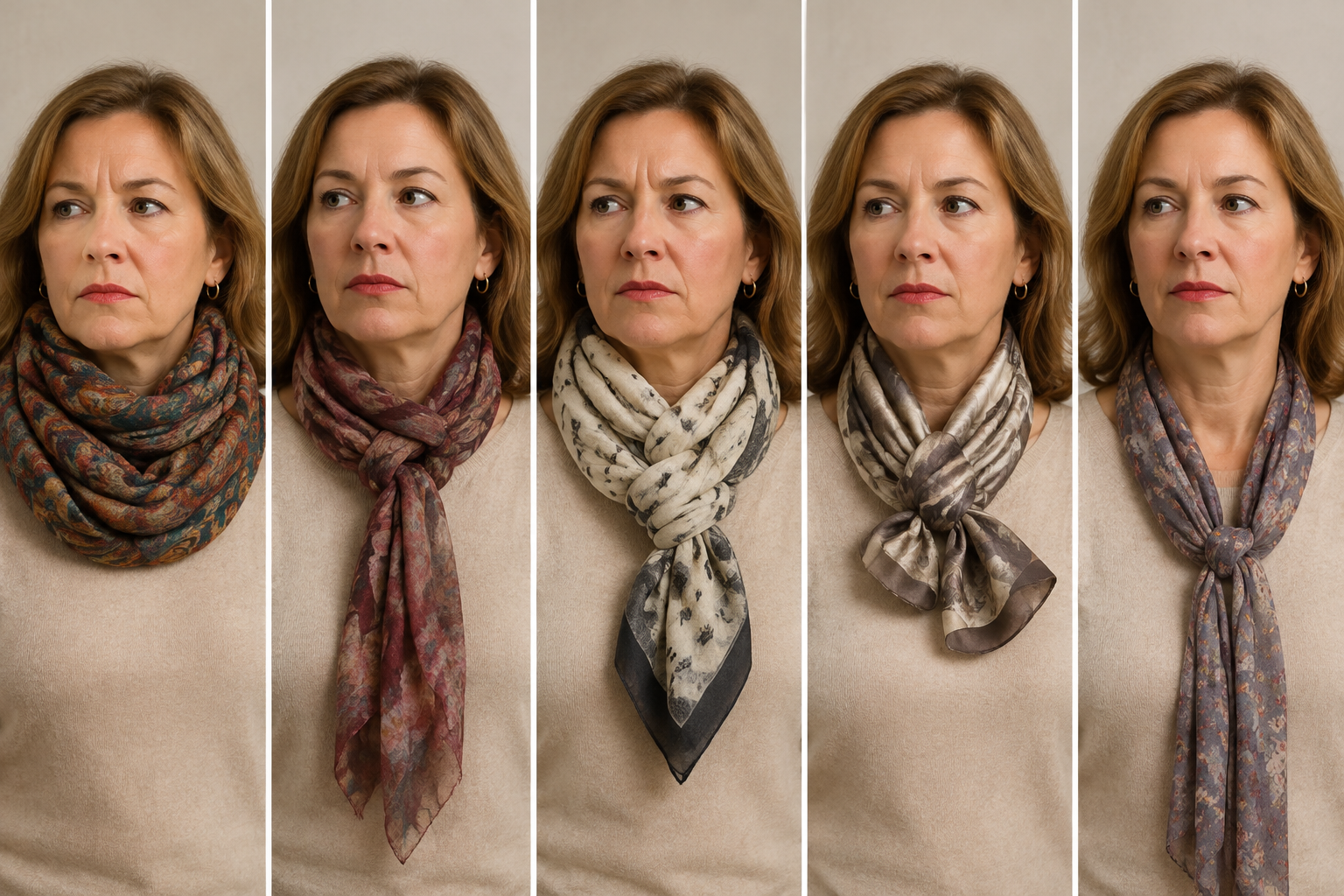
A windy coastal morning exposes bad tying faster than bad taste. The loose Parisian loop, with the scarf folded in half and the ends pulled through, works for ribbed merino and fine cashmere because it tightens without much effort. For cotton gauze and linen blends, a simple once-around with both ends tucked inside the coat is cleaner and warmer. Silk twill wants a compact knot near the side of the neck, close enough to seal the collar but low enough to avoid looking like cabin crew cosplay.
Length matters because wind turns spare fabric into work. Long trailing ends look good in a mirror beside a closed door. Outside, they slap, twist, and tug. The useful test is physical: turn the head, bend to pick up keys, shoulder a bag, zip a jacket. If the scarf shifts during those small movements, it will be worse beside the water.
There is also the question of sound. Some synthetics rustle, some fringe clicks against buttons, some oversized wraps keep brushing the jaw. In still rooms those details seem ridiculous. On a gusty pier at 8 in the morning, they become the whole experience. The scarf that wins is often the one that disappears after the first block, leaving only a warm throat and a coat collar that finally does its job.
What To Leave At Home Before The Wind Picks Up
Open-weave fashion scarves have poor odds near the water. So do oversized acrylic blankets, unless the plan includes carrying them by noon. Very slick polyester squares can be beautiful indoors and maddening outside, sliding open with each gust until the wearer spends more time adjusting fabric than walking. Anything with heavy beads, long tassels, or a loose metallic thread tends to snag on zippers, bag hardware, and the rough edge of public benches.
The most dependable coastal spring scarf has tension in it. Ribbing, twill, crinkle, quilting, a close weave, a grippy brushed surface: some small structural quality has to resist the wind. Without that, even expensive fabric becomes decorative cloth in weather that has no respect for decoration.
By late April, the chosen scarf may spend half the day knotted to a bag handle, smelling faintly of salt and coffee, waiting for the walk home when the sun drops behind the fish market roof and the air off the water turns sharp again.