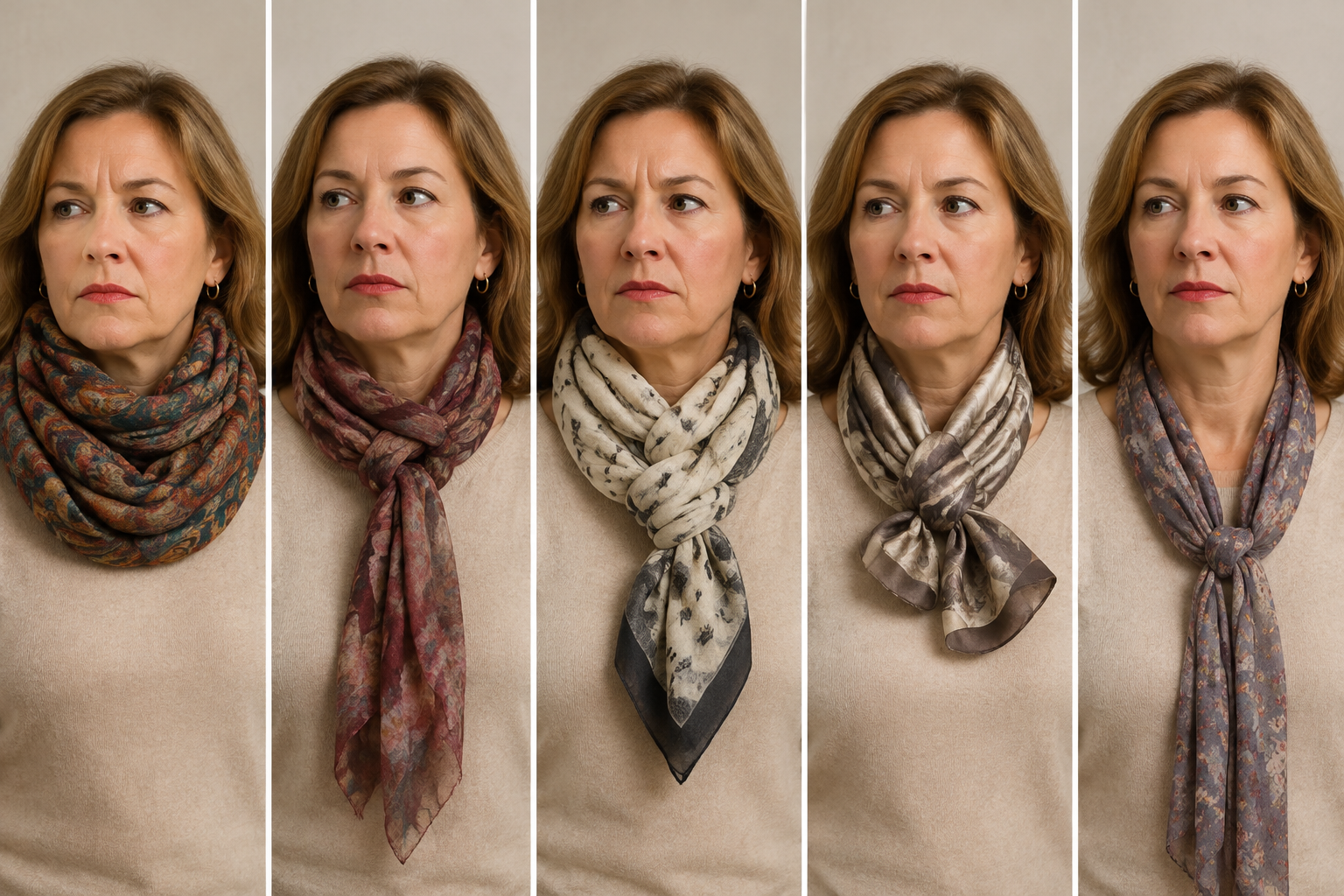
Wool is a hostile environment for a finished face. The fabric is a dense mat of crimped fibers that acts like a fine abrasive, and the collar of a coat is exactly the wrong kind of contact point: it rubs, it traps heat, and it transfers oils in both directions. The result is a familiar urban tragedy. A person spends twenty minutes building a base, walks ten blocks in a good coat, and arrives with a reddish band across the chin where the scarf sat, plus a faint gray fuzz embedded in the foundation near the jawline. The problem is not the makeup. The problem is that most application advice treats the face as a static surface, when a winter commute turns it into a friction interface.
The standard solutions offered online tend toward the useless. Setting spray, for instance, is marketed as armor, but it is mostly a film former that helps pigments adhere to skin. It does almost nothing against the mechanical shear of a wool collar sawing back and forth over a jawline for forty minutes. The friction is the enemy, and fighting friction requires a different set of tactics than fighting oil or humidity. This is a problem of physics, not chemistry, and the fix lives in how a person layers clothing, applies base, and plans the order of operations before leaving the house.
The Real Offender Is the Collar, Not the Scarf
Most people blame the scarf, and the scarf does deserve some blame. But the collar of a wool coat is worse, because it is engineered to sit flush against the neck. A coat collar is a folded double layer of fabric, often reinforced with interfacing or a velvet undercollar, which means it has a rigid edge that presses into the skin. A scarf, by contrast, is a single layer that can be adjusted, fluffed, or repositioned to sit below the chin.
The collar creates a specific type of damage: a horizontal stripe across the lower jaw and down the sides of the neck, exactly where the coat's lapel folds over. This stripe is the signature of winter makeup failure. It shows up as a clean line of missing product, with the skin underneath slightly red from the abrasive action of the wool. A scarf usually creates a messier, more diffuse smudge, because it shifts around and catches on the nose and cheekbones. The collar damage is worse because it is consistent and structural. It happens every single time, in the same place.
The fix begins with understanding that the collar is not a fixed object. A coat's lapel can be folded down or pinned back. A person can wear a thin cotton scarf underneath the coat and then fold the collar over the scarf, creating a buffer zone. The goal is to ensure that no wool ever directly contacts the lower face. This sounds obvious, but it requires a deliberate adjustment at the moment of putting on the coat, not a hope that things will settle naturally.
A Thin Cotton Scarf Beats a Chunky Knit, Every Time
The scarf market in winter is dominated by bulky knits, and those are the worst possible choice for makeup preservation. A chunky knit is a collection of irregular surfaces and gaps. It catches on foundation like Velcro, and the loose weave allows fibers to shed directly onto the skin. A person who wears a thick cable-knit scarf with a full face of makeup is asking for a beard of wool lint by the end of the commute.
The solution is a tightly woven, smooth scarf in a natural fiber. Silk is ideal, because it is slick and does not grip. A silk square or a long silk oblong can be wrapped once around the neck and tucked under the coat collar, and the makeup will slide against it rather than catching. A thin cotton scarf, like the kind used in summer, also works well in winter as an inner layer. The trick is to wear the slippery scarf closest to the skin, and let the chunky knit live on top, visible but not in contact with the face.
This layering strategy is counterintuitive. Most people wear the big scarf because it is warm, and the small scarf because it is fashionable. Reversing that order, with the slick fabric inside and the texture outside, solves the friction problem without sacrificing warmth or style. The chunky scarf still provides insulation, but it sits above the collarbone, away from the jawline, where it cannot do damage.
A Setting Powder Is the Load-Bearing Wall, Not the Setting Spray
Makeup artists talk about "baking" and "setting" as if these were ancient rituals, but the practical function is simple: powder creates a dry surface that resists transfer. Liquid foundation, left to its own devices, stays tacky for hours. A single layer of powder over the top converts that tacky surface into a matte, slightly chalky one. The powder acts as a sacrificial layer. When the wool rubs against the face, it rubs against the powder, not the foundation underneath.
The mistake most people make is using too little powder, or using a powder with a glow finish that contains oils. A powder with any sheen or luminosity is, by definition, not dry. It has emollients suspended in it, and those emollients are exactly what the wool will pick up. The correct powder for winter wear is a mattifying one, applied generously with a puff and pressed into the skin, then brushed off. The finish is flat, but the flatness is what protects the face.
Setting spray, as a final step, is not useless, but it should be applied before the powder, not after. A light mist of spray over the foundation helps the base melt into the skin and gives the powder something to cling to. Spraying on top of powder, as many tutorials suggest, reactivates the powder and makes it tacky again. The sequence matters more than the products.
The Jawline Deserves a Thinner Layer, Not a Thicker One
The instinct when facing a friction problem is to add more product, on the theory that more armor means more protection. This instinct is wrong. A thick layer of foundation is more likely to shift, smear, and lift away from the skin than a thin one. The skin is warm, the fabric is rough, and the combined effect is a sliding action that peels away any excess product. A thick layer also takes longer to dry down, which means it stays tacky longer.
The correct approach is to apply the thinnest possible layer of foundation that still provides coverage, then set it with powder, then leave it alone. This is the opposite of the "full coverage" trend that dominates social media. Full coverage is a liability in winter. It looks great in a controlled lighting setup and disintegrates on a windy street corner. A light to medium buildable coverage, applied in thin passes with a damp sponge, will survive contact with wool far better than a heavy layer applied with a brush.
The jawline specifically should be blended out to nothing. A person should not see a visible line where the foundation ends and the neck begins. The transition should be gradual, fading to bare skin at the point where the coat collar sits. If there is no product on the skin under the collar, there is nothing for the wool to rub off. This sounds like a minor detail, but it is the single most effective trick in this entire article.
Lipstick Transfer Is a Separate Problem with a Separate Fix
Wool coats and scarves do their worst damage to the lower face, and that includes the mouth area. Lipstick transfers to a scarf with alarming ease, leaving a waxy stain that is difficult to wash out. The standard fix, a "liquid lipstick" that dries down to a matte finish, works well but is drying and uncomfortable. The alternative, a tinted lip balm, transfers instantly and offers no real color payoff.
A middle path exists. A person can apply a regular lipstick, blot it thoroughly with a tissue, then dust a tiny amount of translucent powder over the lips through a thin tissue. This is an old theatrical trick, and it works because the powder absorbs the oil in the lipstick and creates a dry surface. The color fades slightly, but the lips will not stain the scarf. The key is to blot aggressively before powdering. A lipstick that has not been blotted is a layer of oil on the lips, and the oil will transfer regardless of what is on top of it.
For a person who refuses to give up a creamy, satin lipstick, the only real solution is to keep the scarf below the lip line. A high collar that covers the mouth, like a turtleneck, is a guaranteed transfer zone. A scarf wrapped low on the neck, leaving the chin and mouth exposed, is safer. This is a styling choice as much as a preservation strategy.
The Order of Operations: Coat On, Then Face, Then Scarf
The single most overlooked factor in winter makeup survival is the sequence of getting dressed. Most people apply their makeup, then put on their coat, then wrap their scarf, and then adjust everything while walking out the door. This sequence guarantees a smear. The coat collar drags across the jawline as it settles onto the shoulders. The scarf rubs against the chin as it is wrapped. The damage happens in the first sixty seconds, before the person has even left the house.
The fix is to reverse the order. A person should put on the coat first, wrap the scarf, and button or zip everything up. Then, with the outerwear fully in place and settled, the makeup goes on. This sounds absurd, but it works. The face is applied after the clothing is arranged, so there is no point at which the fabric drags across fresh makeup. The scarf is already positioned, the collar is already settled, and the face is painted on top of that arrangement.
This approach has a limit: it does not help for a person who wears makeup all day and then puts on a coat to leave work. For that scenario, the earlier advice about powder and thin layers applies. But for the more common scenario, where a person applies makeup in the morning and then heads out the door, reversing the order prevents the most common failure mode entirely. It takes a little practice to get used to, and it feels strange to put on lipstick while wearing a coat, but the payoff is a face that looks the same at the destination as it did in the mirror.
A Compact Mirror in the Pocket Is Not a Weakness
No amount of preparation can fully prevent the physical reality of wearing clothes. A person will sweat under a heavy coat on a crowded train. A scarf will shift during a gust of wind. A collar will dig in on a long walk. The idea that a face can be made indestructible is a marketing fantasy. The practical approach is to accept a small amount of maintenance and plan for it.
Carrying a compact mirror and a pressed powder in a pocket or bag is not an admission of defeat. It is a recognition that the face is a living surface, not a painted wall. A quick check upon arrival, followed by a light touch-up of powder on the jawline and chin, restores the look in under ninety seconds. This is faster and easier than trying to repair a large smear with a makeup remover wipe and a full reapplication.
The pressed powder should be the same one used in the morning application. Using a different powder, especially one with a different finish or undertone, creates a patchy result. The touch-up is about refreshing the existing layer, not adding a new one. A person should press the powder lightly over the affected areas, then blend outward with a clean finger. This is the final step in a system that treats winter makeup as a matter of engineering, not magic.