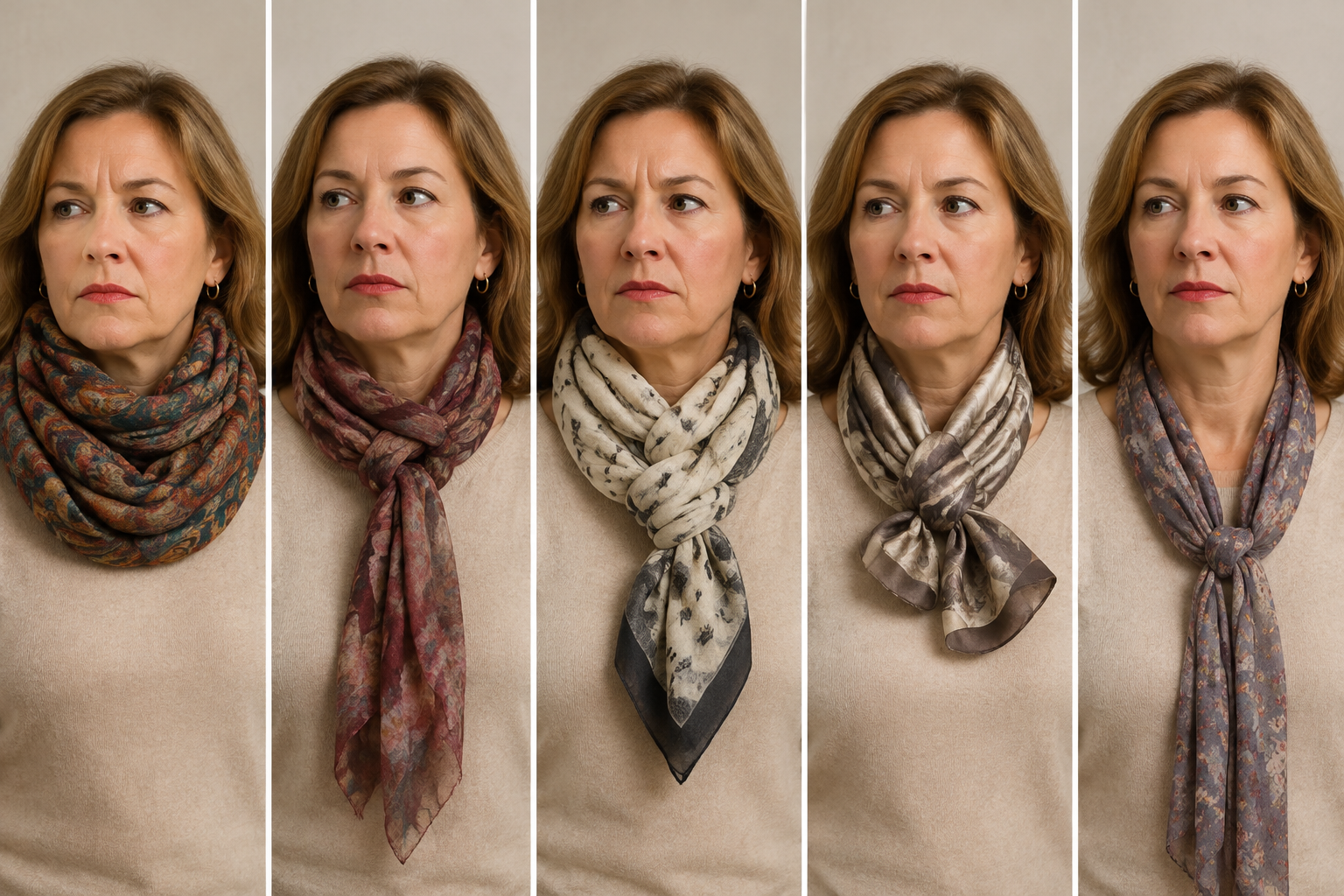
Fabric sheen is the most ignored variable in makeup application, and it causes more mismatched faces than any shade error ever will. A person can nail their foundation shade perfectly, blend like a professional, and still look slightly off, like the face belongs to a different body. The culprit is usually a finish mismatch: a matte face sitting on a satin blouse, or a dewy face bobbing above a flat cotton dress. The face and the fabric are speaking different visual languages, and the brain registers the discord even when it cannot name it.
The relationship is not about matching exactly. A face should not look like a swatch of the same material. But it does need to sit within the same tonal family of light reflection, otherwise the face reads as separate from the outfit, as if it were edited in later. Understanding which finishes belong together starts with admitting that fabric sheen is a spectrum, not a binary. It runs from dead-flat washed linen to high-gloss liquid satin, with every variation of peau de soie, crepe, tulle, and jersey in between.
Reading the Light Off the Cloth
The first step is to look at the fabric in the light the outfit will actually be worn in, not the flattering overhead of a dressing room. Daylight is merciless. It reveals every shimmer particle and every flat patch. Evening light, warm and low, forgives a great deal and rewards luminous textures. A silk blouse that glows softly under department store spots might read as flat and lifeless under a restaurant's amber sconces, and the makeup finish that worked in the store window will be wrong at the table.
Hold the fabric at arm's length and tilt it. Watch where the light catches. A crepe de chine blouse will have a soft, diffused glow that shifts as the body moves. A charmeuse slip dress has sharp, liquid highlights that streak across the surface. A heavy wool coat barely reflects anything, absorbing light rather than returning it. The behavior of light on the cloth, not the cloth itself, is what matters.
Most people make the mistake of matching the fabric's color instead of its sheen. A burgundy satin dress and a burgundy wool dress are two completely different visual events. The satin calls for a face with some glow, something that catches light the way the dress does. The wool calls for a softer, more diffuse complexion, one that absorbs rather than bounces. The color is the same; the light behavior is not.
The Four Finish Families That Matter
Makeup finishes sort into four practical families, and each one corresponds to a range of fabric behavior. Matte sits at one end, completely light-absorbent. Natural skin finish, often called satin or semi-matte, gives a soft, lit-from-within effect with no visible shimmer. Dewy or luminous finish has visible glow, sometimes with a wet look, and catches light across the high points of the face. The fourth family is the true high-shine or metallic finish, which is rare in everyday wear but appears on editorial looks and certain highlighters.
Each family has a fabric counterpart. Matte pairs with wool, thick cotton, linen, denim, and any fabric with a napped or brushed surface. Natural satin finish pairs with polished cotton, crepe, jersey, and matte silk. Dewy finish pairs with charmeuse, satin, silk, and anything with a liquid reflection. The metallic family belongs with sequins, lamé, and high-gloss synthetics, though wearing those fabrics in daylight is a separate debate entirely.
The mapping is not a strict one-to-one. A dewy face over a matte cotton dress can look intentional if the skin is otherwise flawless and the glow is subtle. But the opposite direction fails almost every time. A matte face over a satin dress looks dry and flat, like the skin has been powdered into submission. The fabric's high light reflection makes the face look dull by comparison, and the whole effect lands as tired rather than polished.
Where the Neck and Chest Enter the Equation
The face does not exist in isolation. The neck, chest, and shoulders are part of the visible field, and they interact with the fabric directly. A deep V-neck satin blouse exposes a swath of skin that sits against glossy fabric all evening. If the face is dewy but the chest is powdered matte, the transition is stark. The skin on the chest needs the same finish treatment as the face, or at least a finish that does not contradict it.
This is where most makeup applications fall apart. A person will carefully build a luminous base on the face, then stop at the jawline, leaving the neck and chest with whatever residual product happened to rub off the collar. The result is a glowing face hovering above a matte, flat chest, with the satin dress reflecting light and making the skin texture look rougher than it is. The fix is simple: extend the finish, not just the foundation shade, down the neck and across the clavicles.
The reverse problem appears with high-neck or turtleneck tops. When fabric covers the neck entirely, the face is the only skin visible, and the finish has no competition from adjacent skin texture. This gives more freedom. A matte face over a cashmere turtleneck works beautifully because the absorbent fabric echoes the absorbent skin. A dewy face over the same turtleneck can work too, if the glow is maintained on the ears and the visible strip of forehead, but the contrast between glowing skin and flat knitwear requires a confident hand.
The Texture of the Fabric Matters as Much as the Shine
Sheen is only half the story. The physical texture of the fabric, its roughness, smoothness, napped surface, or open weave, changes how the eye processes the skin next to it. A chunky cable-knit sweater has a pronounced three-dimensional surface. Even in a flat color with no sheen, the knit casts tiny shadows across its own surface. A completely matte, flat face next to that texture can look almost too smooth, like a mannequin head. Adding a subtle natural finish gives the skin its own soft texture, so the eye has something to read against the knit's shadows.
Smooth fabrics behave differently. A tightly woven silk or a polished cotton has a surface with almost no texture, just color and sheen. Next to that, skin texture becomes the dominant visual element. A heavy matte foundation that emphasizes pores or dry patches will look worse against smooth satin than against rough wool, because the satin provides no visual noise to distract from the skin's irregularities. The smoother the fabric, the more forgiving the skin finish needs to be.
Open weaves, like linen or eyelet, have a textured surface that reads as casual and breathable. A heavy, full-coverage matte face fights that airy quality. Linen wants skin that looks like skin, with visible pores and natural variation, which is why a light-touch natural finish is almost always the right answer for summer linen outfits. The fabric is honest about its texture, and the face should be too.
Event Lighting Overrides the Fabric
There are occasions where the fabric sheen is irrelevant because the lighting conditions dominate everything. Outdoor daytime events are one. In direct sunlight, highlighter particles scatter and look glittery, and dewy finishes can read as sweaty. Even if the dress is liquid satin, a daytime wedding or garden party does not support a glowing face. The sunlight does the glowing for everyone. A natural finish, leaning slightly matte, is the safe call regardless of fabric.
Indoor evening events flip the calculation. Low, warm light kills matte finishes, which can read as flat and lifeless with no natural light to create dimension. The same satin dress that looked excessive in daylight becomes the perfect partner for a dewy face in candlelight. The dress reflects the available light, and so does the skin, and the two glow together. This is why the same outfit can demand opposite makeup finishes depending on the hour.
Dance floors and venues with colored or moving lights add another layer. Strobe lights and disco balls create sharp, moving highlights that catch shimmer particles on the face and turn them into a constellation of dots. A subtle satin finish under normal light becomes a glitter bomb under a strobe. For club wear, either commit to the metallic realm with deliberate high-shine particles, or go matte and let the light show be the only shimmer in the room.
Proportion Rules for Statement Finishes
When one element is extreme, the other should be restrained. A dress with an aggressive liquid sheen, like a glossy PVC or a high-shine charmeuse, demands a face that does not compete. A matte face with a strong lip is the classic pairing. The dress provides all the shine, and the face provides contrast. Attempting to match the dress's gloss with an equally glossy face creates a sensory overload where nothing stands out.
The same logic applies to heavily textured fabrics. A dress covered in sequins or paillettes reflects light from a thousand tiny points. A dewy or metallic face on top of that is chaos. The eye cannot settle on anything. A matte face, on the other hand, anchors the look and gives the sequins a calm surface to play against. The proportion rule is simple: one shiny element per look, and the face is almost never the element that should win.
This is why the classic evening uniform, a black satin slip dress with a matte skin finish and a red lip, works so reliably. The dress owns the shine. The face owns the color. The skin stays out of the way. Every time the proportion rule is violated, the look falls apart in a way that is hard to diagnose but easy to see.
The Casual End of the Spectrum
Everyday wear, the cotton t-shirts, the knit sweaters, the denim jackets of the world, does not require this level of analysis. Most casual fabrics have low or no sheen, and most casual makeup should follow suit. A natural finish is the default for good reason. It works with almost everything a person wears on a normal day, and its soft sheen reads as healthy rather than deliberate.
The trap at the casual end is over-matching. A person wears a matte black t-shirt and assumes they need a completely matte face, so they powder heavily and end up looking dry and flat. A t-shirt has negligible sheen, but it also has negligible texture, and a completely matte face next to it can look mannequin-like. A natural finish with a light hand is the better answer. The goal is not to match the fabric's complete lack of light reflection, but to give the skin a believable, healthy surface that does not contradict the outfit's ease.
Athletic wear is the notable exception. Technical fabrics, the moisture-wicking knits and performance meshes, often have a subtle synthetic sheen that photographs as slightly glossy. Next to these, a heavy matte face looks out of place, almost dusty. A light, breathable makeup finish, or no makeup at all, aligns better with the fabric's active, glossy character.
The Final Check Happens in the Mirror, Not the Phone
Before leaving the house, the last check should happen in a full-length mirror with the outfit fully on, in the actual lighting the event will have. The same mirror used to apply the makeup is useless for this check because the lighting is fixed and flattering. A hand mirror in the hallway, a bathroom mirror with the door open, any spot that catches different light, works better. The face should be examined from a distance, not up close.
Phone cameras are a lying tool for this purpose. Front-facing cameras flatten light and smooth texture, and their automatic exposure adjustments mask finish differences. A look that appears cohesive in a selfie can be a disaster in person. The opposite is also true. The camera cannot replicate the way fabric sheen and skin finish interact in real space, so the phone is useless for this judgment. The eye in a mirror, at arm's length or further, is the only reliable judge.
One practical test: if the face and the outfit each catch the eye separately, the pairing failed. When the finish relationship works, the eye moves across the whole figure without stopping at the fabric-skin boundary.