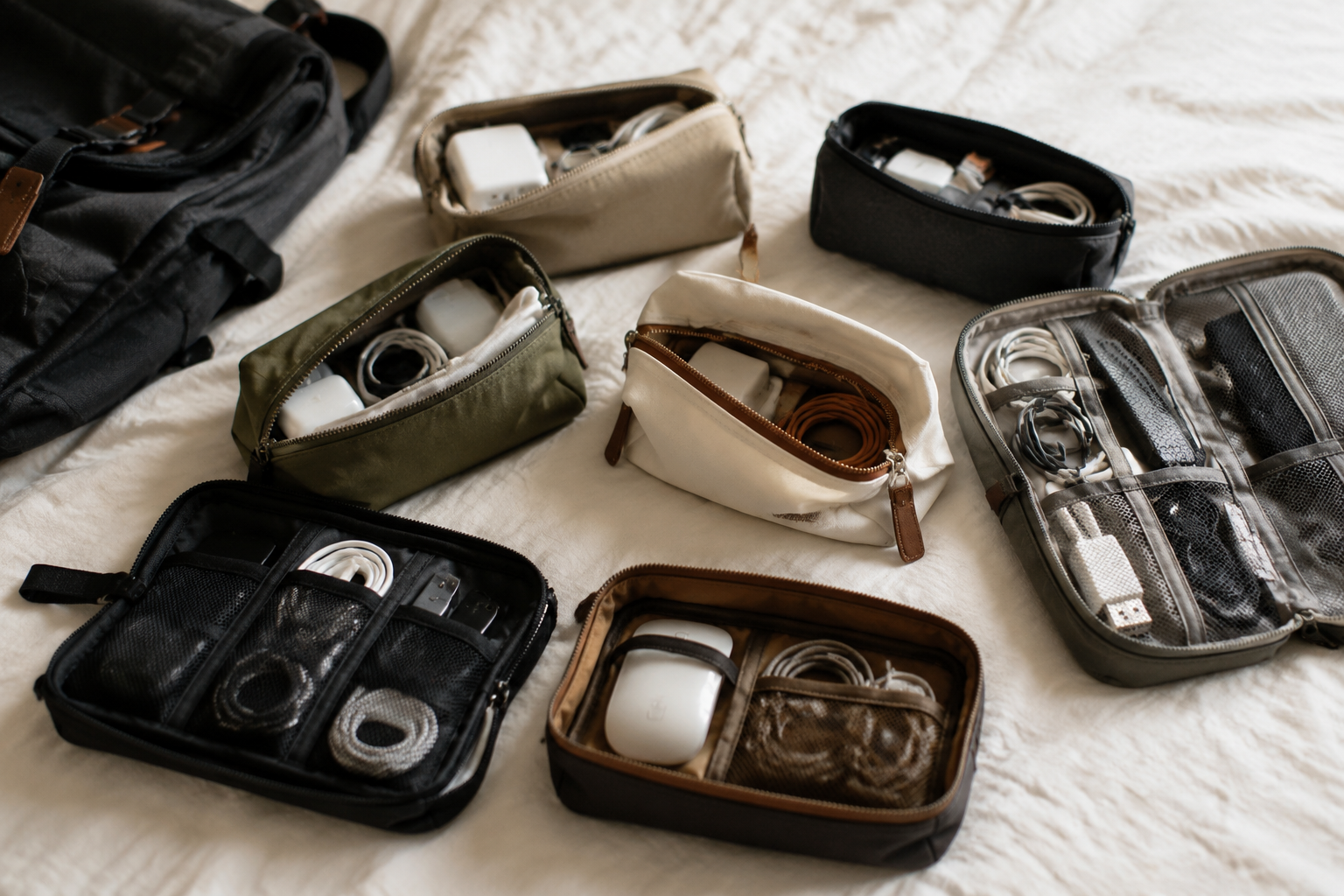
Three bags. Not two, not five, and not the twelve that live in the back of a hall closet. The practical three-bag rotation is one of the most repeated pieces of advice in men's style writing, and it is almost never accompanied by actual numbers. The advice usually stops at "rotate your bags so they age evenly" or "give each bag a rest." What that advice never says is what the rotation costs, both in cash outlay and in the daily friction of maintaining it.
The honest answer is that a real three-bag rotation costs somewhere between $800 and $2,500 to start, assuming a person buys new and buys well. That range sounds obscene to someone who has carried the same $40 canvas tote for six years. It sounds reasonable to someone who has already spent $400 on a single leather briefcase that now sits in a corner because it is too heavy for a Tuesday commute. The gap between those two people is not about income. It is about how they understand what a rotation is for.
A rotation is not a collection. It is not three bags that each serve a different "occasion," like a dress bag for weddings, a work bag for the office, and a weekend bag for travel. That is a wardrobe, and it is a fine thing to have, but it is not a rotation. A rotation is three bags that can all do the same job, cycled so that no single bag takes the daily abuse. The point is to make each bag last several times longer than it would if carried every day, and to spread the visible wear across three items so the whole set looks presentable for years.
That distinction matters because it changes what a person should buy. A rotation of three bags for the same purpose means buying three bags that are roughly equivalent in quality and capacity. It does not mean buying one great bag, one okay bag, and one cheap bag that gets carried only when the other two are wet. The cheap bag defeats the purpose. The entire system only works if all three are worth carrying, because the rotation only works if a person actually uses all three.
The real cost of three usable bags
For a leather briefcase or a waxed canvas work bag, the floor for something a person can carry daily without embarrassment is somewhere around $250 to $350 new. Below that price, the leather is usually corrected grain with a plastic coating, the stitching is nylon that frays, and the hardware is zinc that tarnishes within a year. These bags do not age well. They do not develop a patina. They develop scuffs that reveal a gray cardboard-like core underneath the finish, and the handles start pulling away from the body after about eighteen months of daily use.
Three bags at that floor price, around $300 each, puts the initial cost at $900. That is the low end of a serious rotation, and it assumes the buyer finds good sales or accepts bags from brands that are not heritage names. If a person wants bags from the well-known makers, the ones whose names appear in every "buy it for life" list, the price per bag jumps to $500 to $700. Three of those is $1,500 to $2,100. Add a decent backpack to the mix, since many people alternate between a briefcase and a backpack depending on the day, and the number climbs past $2,500.
None of this accounts for the accessories that a rotation quietly demands. A leather bag needs conditioner applied a few times a year, which is another $20 to $40 for a small container. Waxed canvas needs re-waxing eventually, which is another $25 for a tin. These are small numbers, but they are recurring, and the entire point of a rotation is that the bags last long enough for maintenance to matter.
What the rotation buys beyond longevity
The financial case for a rotation is simple: three $400 bags rotated daily will last longer than one $1,200 bag carried daily. Leather and canvas both need rest periods to recover from moisture and stress. A bag carried every day never gets that rest. It absorbs sweat and rain, it gets compressed under the weight of a laptop, and it never fully dries out. A bag carried every third day gets two full days to air out between uses. That rest period is not a luxury. It is the difference between a bag that looks good for three years and one that looks good for ten.
But the cost argument misses the more immediate benefit. A rotation also means a person never has to carry a bag that is in a bad state. The bag that got caught in the rain yesterday sits at home drying. The bag that picked up a coffee stain on the handle gets a week off until it can be cleaned. The bag that is simply looking tired after a month of daily use gets rotated out just as its appearance starts to slide. This is the practical benefit that no single bag, no matter how expensive, can provide: the ability to send a bag to the bench.
That bench time is worth real money. A person who carries one bag daily will eventually carry a bag that looks rough on an important day, because there is no alternative. The rotation removes that failure mode entirely. It is insurance against the bad day, and the premium is the cost of the third bag.
The weight of carrying a rotation
The cost in dollars is only half the price. The other half is paid in daily friction, and most people who try a rotation quit because of this friction, not because of the money.
A rotation requires transferring the contents of one bag to another every day. Not every other day. Every single day, unless the person is disciplined enough to pack three identical bags on Sunday night and leave them ready. The transfer takes about two minutes in the morning and another minute at night, assuming the person works a standard schedule and empties the bag when they get home. That is fifteen minutes a week, an hour a month, twelve hours a year spent moving a laptop, a charger, a notebook, a wallet, keys, and whatever else lives in the bag.
Twelve hours a year does not sound like much until a person accounts for the failure rate. The phone charger gets left in the bag that is now at home. The notebook goes into the wrong bag. The transit pass, the one that lives in a specific pocket, is suddenly not in the pocket because this bag has a different pocket layout. The friction is not the transfer itself. The friction is the mental tax of remembering which bag has what, and that tax is paid every morning when a tired person is trying to get out the door.
This is why the rotation fails for most people who try it. It is not a money problem. It is a systems problem. The only people who sustain a rotation are the ones who either accept the daily transfer as a ritual, like making coffee, or the ones who buy three identical bags so the pockets and layout are the same. Identical bags are the cheat code. They eliminate the mental tax entirely, at the cost of making the rotation invisible. Nobody will notice that a person owns three identical brown leather briefcases. They will just notice that the bag always looks good.
Buying three at once versus building over time
The smart way to build a rotation is not to buy three bags at once. The cost is too heavy in a single month, and more importantly, a person does not yet know if they will tolerate the rotation habit. The smarter path is to buy one good bag, carry it for six months, and then buy a second bag that is similar in capacity but different in material. Carry the two in rotation for a few months. If the habit sticks, buy the third. If the habit does not stick, the person is out one extra bag and can sell it at a modest loss, or keep it as a spare.
This staggered approach also solves a subtle problem with buying three identical bags at once. Bags from the same maker, bought in the same year, will age similarly because they are made from the same hide or the same batch of canvas. That sounds good until a person realizes that the whole point of a rotation is to spread wear. If all three bags are identical and all three are rotated perfectly, they will all reach the end of their life at roughly the same time. The person then faces the cost of replacing three bags in the same year. Buying bags at different times, from different batches, staggers the replacement cycle as well.
There is also a case for mixing materials across the rotation. A leather bag, a waxed canvas bag, and a ballistic nylon bag all serve the same daily function, but they behave differently in different weather. Leather is the dressiest and the most fragile in heavy rain. Waxed canvas is tougher and ages with a rugged look, but it needs re-waxing every couple of years. Ballistic nylon is nearly indestructible and dries quickly, but it never develops character and looks permanently casual. A rotation of all three gives a person the right tool for the season, and the visual variety keeps the rotation from feeling monotonous.
The hidden cost of storage and care
Three bags need a home. A single bag can live on the floor by the door or draped over a chair. Three bags need shelf space or a hook or a dedicated spot in a closet, and each bag should be stored properly if it is going to last. Leather bags need to be kept away from direct sunlight and heat. Waxed canvas needs airflow to prevent mildew. A person who lives in a small apartment, the kind where the entryway is also the kitchen and the bedroom, has to solve this problem before the rotation can start.
The care routine also scales with the number of bags. One bag gets conditioned when it looks dry. Three bags get conditioned on a schedule, because the visible signs of dryness are harder to spot when each bag is only carried a third of the time. The maintenance moves from reactive to proactive, and proactive maintenance requires calendar reminders or a standing habit. A person who cannot remember to water a houseplant will struggle with this.
None of these costs are dealbreakers. They are just real, and they are rarely mentioned in the standard advice. The advice always presents the rotation as a money-saving strategy, which it is over a decade-long horizon, but the upfront cost is real and the daily habit is real and the storage is real. A person should go into it with their eyes open.
A cheaper rotation that still works
The $900 to $2,500 range assumes a person buys new leather or waxed canvas bags from established makers. There is a cheaper path, and it is not buying cheap new bags. It is buying used bags from the same established makers.
The secondhand market for quality bags is soft. A bag that retailed for $500 five years ago regularly sells for $150 to $250 on resale sites, especially if it has visible wear. For a buyer who is willing to accept a bag that already has a patina, the cost of a three-bag rotation drops to $500 or $600. This is the single best way to enter a rotation, because the used bags have already done their initial break-in and the buyer can see exactly how the leather ages before committing to the aesthetic.
Used bags also solve the identical-bag problem. A person hunting on the secondhand market can find two or three of the same model from different years, and the subtle differences in leather batch and manufacturing date make it easier to tell them apart while keeping the same pocket layout. The rotation becomes functionally identical without being visually identical.
The risk with used bags is that the previous owner did not care for them. A used bag with cracked stitching or a broken zipper is not a bargain at any price, because repairing a bag costs $50 to $150 per repair and erases the savings. The buyer has to inspect the bag in person or ask sharp questions about the state of the hardware and the lining. The lining is the part that fails first in most bags, and it is also the part that is hardest to repair.
The point of the whole exercise
What a practical three-bag rotation actually costs, in full, is about $1,500 new or $600 used, plus twelve hours a year of transferring contents, plus six square feet of storage space, plus a small maintenance budget that runs $50 to $100 a year. The payoff is that a person never carries a bag that looks worn out, never worries about rain on an important morning, and replaces the entire system once a decade instead of every two years.
The math only works if the person actually does it. A rotation is a habit with a price of admission, not a purchase that delivers value on its own. The person who buys three bags and then carries the same one every day because the transfer is annoying has spent triple the money for zero benefit. The person who buys three bags and treats the rotation as a small daily ritual, the way they treat making the bed or grinding coffee, gets a decade of use from bags that would have lasted three years under single-bag duty.
The last thing to consider is what happens when one bag in the rotation finally dies. The instinct is to replace it immediately with the same model. The better move is to look at the surviving two and ask whether the rotation still serves the current life. A person who has changed jobs, changed commutes, or changed how much they carry should not buy the same bag out of loyalty. The rotation is a system, not a collection. It should be edited when the life it serves changes. That is the real skill, and it is the part that never appears in the advice columns.