What You Need for Evening Bag Essentials Without Overpacking
The evening bag is the last thing a person packs and the first thing they regret. It sits on the dresser, tiny and pretty, while the phone, keys, card case, lipstick, and whatever else gets shoved inside create a soft-sided geometry problem that never quite works out. A clutch that bulges at the seams reads as careless. A wristlet that cannot hold a driver's license reads as impractical. The whole category feels like a trap designed to punish anyone who actually needs to get somewhere and back without carrying a tote.
Most advice on this subject takes one of two wrong turns. Either it recommends a bag the size of a small paperback and tells the reader to simply leave everything at home, which ignores the reality of keys and cards and a phone at 11 p.m. Or it suggests a structured mini bag that holds plenty but fights the outfit, turning a silk slip dress into a costume with a hard leather box strapped across it. Both approaches miss the actual point: the evening bag should disappear into the night, not announce itself as a burden or a statement.
The fix is not a bigger bag. The fix is a stricter edit of what goes inside one, paired with a bag shape that works with physics instead of against it. A phone, a card case, a lip product, and a key are the realistic ceiling for most nights out. Everything else is a story a person tells themselves about being prepared.
The Phone Dictates Everything
Before choosing a single accessory, measure the phone. This sounds absurdly practical for a subject that is supposed to be about glamour, but the phone is the largest object that will ever go in the bag, and it sets the floor for how much interior space is required. A modern smartphone with a case runs roughly 6 to 7 inches tall and 3 inches wide. That measurement eliminates half the evening bags on the market immediately.
A bag that forces the phone in diagonally, with the top corner digging into the lining, is a bag that will be abandoned by March. The phone needs to drop in vertically, with room to spare at the top so the closure does not strain. This single test, performed at the store or in front of the mirror before buying, filters out more bad purchases than any other consideration. If the phone does not fit comfortably, the bag is not an evening bag. It is a decorative object.
The secondary phone consideration is access. Some venues have coat checks, but most restaurant tables and bar stools do not offer a place to dig through a bag. A phone that requires two hands and a flashlight to retrieve is a phone that ends up on the table, which defeats the purpose of carrying it discreetly. The ideal evening bag opens wide enough for a hand to enter and find the phone without fishing around. A rigid clasp that snaps shut with a loud click is fine for a museum gala, where no one is checking messages. For an actual evening, a magnetic closure or a soft fold-over flap wins.
One Card Case Instead of a Wallet
The full-size wallet has no place in an evening bag. It is a brick of receipts, loyalty cards, and expired IDs that adds weight and bulk without adding any value to a night out. The replacement is a card case: a slim fold of leather or metal that holds an ID, one credit card, and a folded bill or two. That is the entire financial apparatus required for dinner, a drink, and a ride home.
Card cases come in two useful materials. Leather versions soften over time and mold to the shape of what they hold, which means they slip in and out of a small bag without catching on the lining. Metal versions are thinner and offer better RFID protection, though they can be harder to grip when sliding them out of a tight pocket. Both work. What does not work is a card case that zips or has a coin pocket, because those add thickness and turn the simple act of paying into a small unpacking ritual.
Some people argue for skipping the card case entirely and tap-to-pay with the phone, which is valid until the phone dies or the restaurant's terminal rejects the contactless signal. A single card tucked into an interior slip pocket of the bag works as an emergency backup, but carrying one card loose invites it to slide under the lining or vanish into the seat cushions. A dedicated card case keeps the essentials grouped and findable.
Keys Need a Home, Not a Pocket
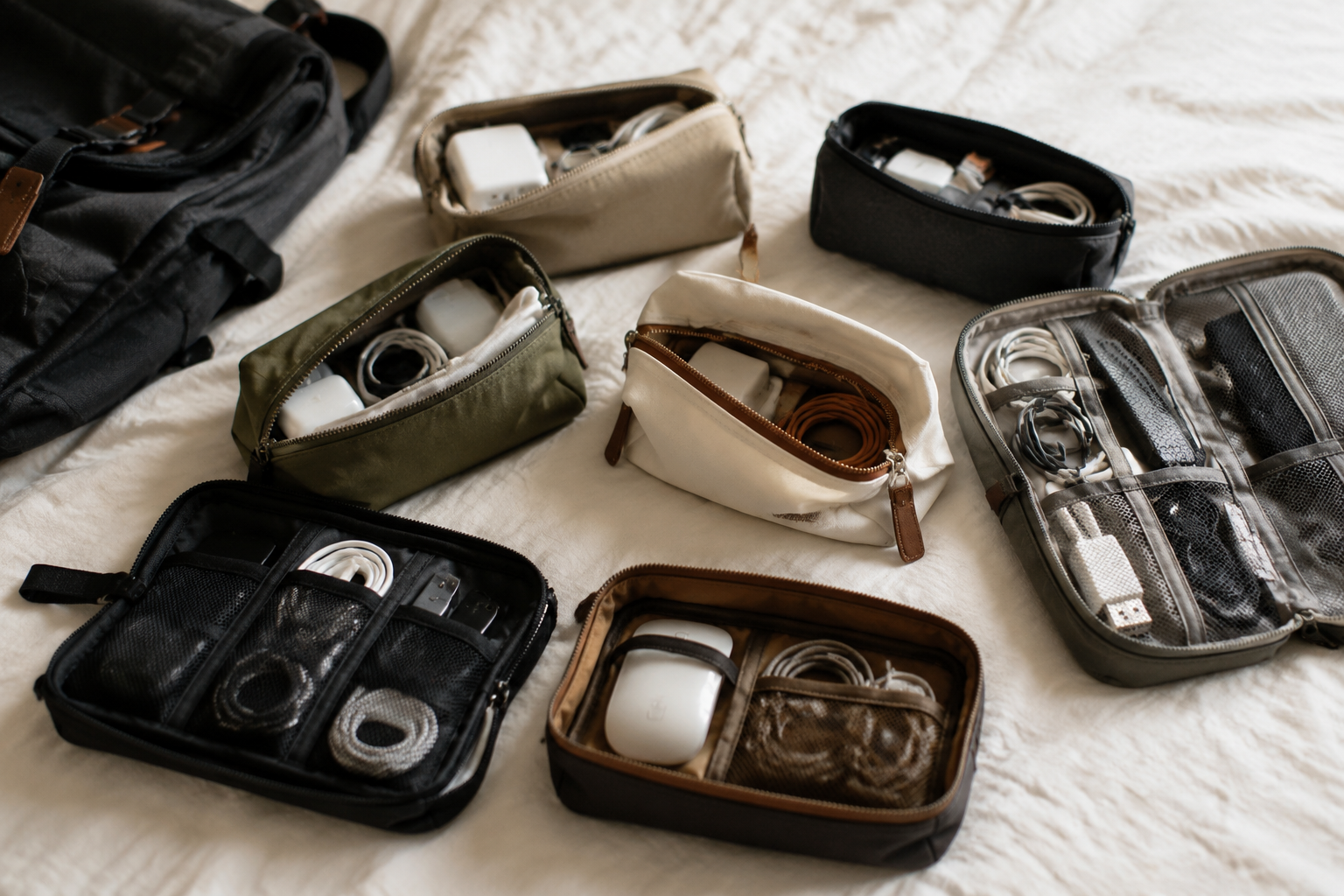
Keys are the most annoying object to pack into a small bag because they are sharp, heavy, and capable of scratching the phone screen or the interior leather. Tossing a key ring into the bottom of a clutch is a recipe for a scratched phone within a week. The solution is a key holder that separates the metal from everything else.
A small leather key pouch, the kind that holds one or two keys in a slip with a loop, is the right scale. It costs little, takes up almost no room, and keeps the sharp edges contained. The alternative is to use one of the bag's interior pockets if it has one, but many evening bags sacrifice interior organization entirely for a single open cavity. In that case, the key pouch is not optional.
For people who drive to the venue, the car key fob is an even more awkward shape. It is bulky and often has a metal key blade folded inside. The fob should ride in the same leather pouch, or in a dedicated exterior pocket if the bag has one. Leaving it in the car is not an option when valet parking or a parking garage is involved. The pouch solves this without adding a second loose object to the bag.
Lip Product and One Compromise Item
The makeup question is where evening bag packing goes off the rails. A full touch-up kit with foundation, concealer, powder, a brush, and three lip colors turns a clutch into a cosmetic case. The realistic requirement for a night out is one lip product and possibly one small item for emergency repairs, like a blotting paper or a mini powder compact. That is it.
The lip product should be chosen for the specific evening, not carried as a generalist. A satin lipstick for dinner and drinks. A tinted balm for a long outdoor event. A liquid lipstick for a night of dancing where reapplication needs to be quick. The idea is to carry the one product that matches the plan, not the three that might work.
The compromise item, if any, should be tiny. A single blister pack of pain reliever, one folded tissue, a small hair tie. These fit flat along the bottom of the bag and do not interfere with the phone's position. Anything larger, a compact mirror, a full tissue pack, a mini hand sanitizer, starts to crowd the phone and turns the bag back into a jumble.
Bag Shapes That Actually Work
With the contents settled, the bag itself becomes a question of silhouette and grip. The most reliable evening bag shapes are the clutch, the wristlet, and the small shoulder bag. Each has a specific set of strengths, and none of them works for every situation.
The flat envelope clutch is the classic for a reason. It holds a phone and a card case without bulging, and it tucks under an arm or into the curve of a hand. The drawback is that it occupies a hand at all times, which matters when holding a drink, a plate, or a partner's hand. A wristlet solves this by strapping around the wrist, but the strap makes the bag hang and swing, which can be annoying when walking or dancing.
The small shoulder bag, sometimes called a micro bag or a mini crossbody, is the most practical option for anything involving movement. It keeps the hands free, it cannot be set down and forgotten, and it distributes the weight across the body. The aesthetic downside is real: a crossbody strap can break the line of a dress or a tailored suit. The compromise is a shoulder bag with a short chain strap that sits at the top of the arm, which keeps the line cleaner while still freeing the hands.
Materials matter as much as shape. A soft leather or satin bag gives slightly, allowing the phone to slide in even when the opening is a touch smaller than ideal. A rigid metal or acrylic bag looks stunning but offers zero forgiveness; the phone must fit exactly or the bag does not close. Structured bags photograph beautifully, but they are the ones that end up shoved under a chair because they are too awkward to hold and too rigid to enjoy.
The Test of an Evening Bag
Before committing to any evening bag, run it through a three-second routine at home. Load it with the phone, the card case, the key pouch, and the lip product. Close it. Then pick it up and hold it the way it would be held at the venue, whether that is in one hand, on the wrist, or across the body. If anything digs into the palm, if the closure pops open, if the phone shifts so much that it presses against the clasp, the bag fails.
This test catches the problems that do not show up in a store, under bright lights, with the bag empty. It also reveals the weight of the bag itself. A chain strap adds surprising heft. A metal frame adds more. The loaded bag should feel light enough to forget about, because the moment it feels heavy, it will be put down somewhere and left behind.
The other test is the one-handed retrieval. At a restaurant, at a bar, or on the street, the phone and the card case need to come out and go back in without setting the bag down. If the bag requires two hands to open, or if the contents shift into an unreachable corner, it is a beautiful annoyance. The best evening bag disappears into its own function, and a person gets through the night without once thinking about where the phone is.
Evening bags get a reputation for being impractical, but the problem is usually the packing, not the bag. A clutch that holds a phone vertically, a card case, a contained set of keys, and a single lip product is a bag that works. The rest is a matter of discipline at the front door, leaving behind the wallet, the full makeup bag, and the loose change that turns a sleek object into a stuffed purse. Pack for the actual night, not the hypothetical one, and the evening bag stops being a compromise and starts being the easiest part of getting out the door.